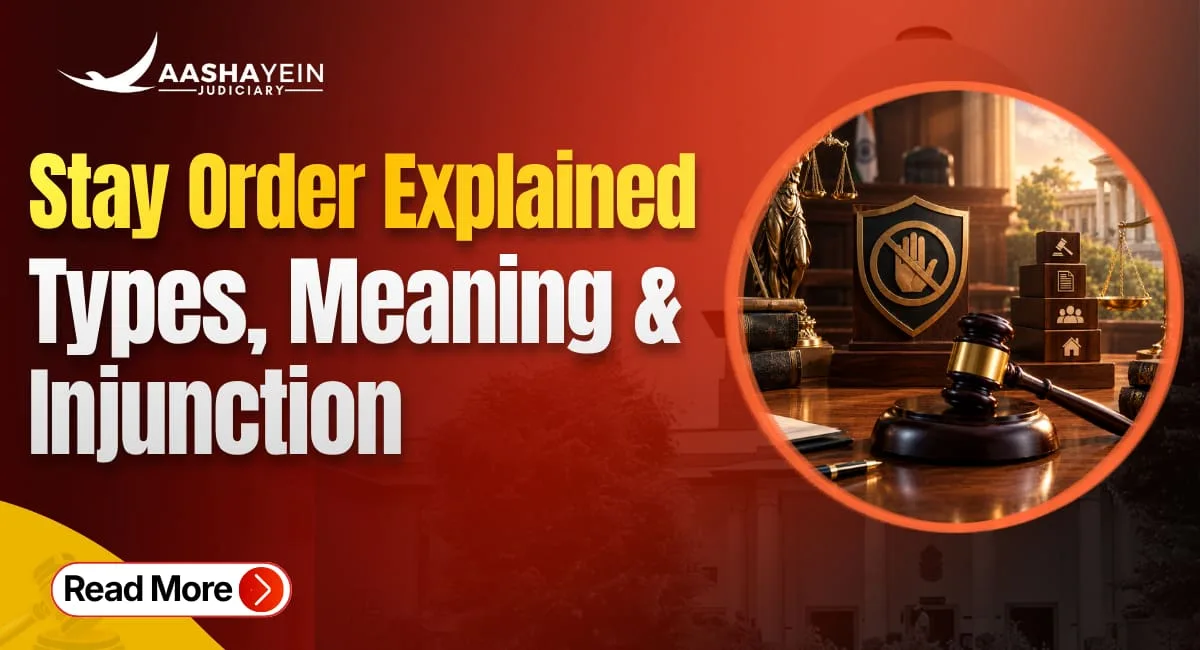
A stay order is a temporary suspension of judicial proceedings or of the execution of an order by a competent court. It is interim relief, not a final decision. Its job is to prevent irreparable harm and keep the position as it is until the case is decided on merits.
A caution on the source: the page I used states that it was generated with AI help and may contain errors. It also covers Order 41 Rule 5 CPC but does not mention Section 151 CPC or Order 39, which the plan lists. Treat the case citations and the six-month rule below as points to verify against the original.
Types of stay
· Stay of proceedings: halts a case, for example where parallel litigation is pending or jurisdiction is disputed.
· Stay of execution: prevents enforcement of a decree or order, such as an appellate stay of a money decree.
· Stay of operation of an order: suspends the effect of a particular order, such as a cancelled licence.
· Interim stay: granted early, usually until the next hearing.
· Permanent stay: described as rare, used where further proceedings would abuse the legal process.
Where the power comes from
· The inherent powers of courts.
· The Bharatiya Nagarik Suraksha Sanhita, 2023, which succeeded the CrPC.
· Order 41 Rule 5 CPC, under which an appellate court can stay execution of a decree.
· Articles 32 and 226 of the Constitution for writ jurisdiction.
· Special laws such as the Arbitration and Conciliation Act, the Consumer Protection Act and tax laws.
Also Check: Anticipatory Breach of Contract: Rights & Remedies
When is a stay granted
A stay is discretionary and not routine. The article lists four considerations: a prima facie case, balance of convenience, irreparable injury and "clean hands," meaning full and honest disclosure.
Stay and injunction
An injunction is a broader remedy that directs parties to act or refrain from acting. A stay specifically suspends the operation of a judicial order or proceeding. For the related ideas on injunctions, see our post on temporary and permanent injunctions.
Procedure
· File an application with the appeal, revision or writ petition.
· Support it with an affidavit.
· The court usually issues notice. In urgent cases, an ex parte interim stay may be granted, subject to later review.
· Both sides are heard.
· The court sets the scope, duration and terms.
How long a stay lasts
Generally until the next hearing, until the appeal or petition is disposed of, or until further orders. The article says that under Asian Resurfacing of Road Agency Pvt. Ltd. v. CBI (2018), trial-related stays lapse after six months unless extended by a reasoned order.
Watch Our You Tube Video:
BSA 2023 in One Shot | Bharatiya Sakshya Adhiniyam 2023 Explained
Cases the article cites
· K.K. Velusamy v. N. Palanisamy (2011): inherent powers may support a stay in exceptional cases.
· State of Uttar Pradesh v. Ram Sukhi Devi (2005): a stay of operation does not automatically revive an earlier order.
· Shree Chamundi Mopeds Ltd. v. Church of South India Trust (1992): distinguishes a stay of operation from quashing an order.
Effects and misuse
Violating a stay amounts to contempt, with possible fines or imprisonment. The litigant gets protection from immediate harm. Critics say frequent stays cause delay. Stays are sometimes used to drag out proceedings through frivolous applications, resist eviction or stall prosecutions, and courts have cautioned that stays must not be indefinite.
Practice Judiciary Previous Year Questions to understand exam patterns, identify important legal topics, and improve accuracy. Solve state-wise question papers to strengthen your concepts, assess your preparation, and build confidence for Judicial Services Exams.
FAQs
What is a stay order?
A temporary suspension of proceedings or of execution of an order by a competent court.
Is a stay a final decision?
No. It is interim relief.
Which rule lets an appellate court stay execution of a decree?
Order 41 Rule 5 CPC.
What is a stay of execution?
An order that prevents enforcement of a decree or order.
How is a stay different from an injunction?
An injunction directs parties to act or refrain from acting. A stay suspends the operation of an order or proceeding.
What happens if a stay is violated?
It amounts to contempt of court.
What does the article say about duration under Asian Resurfacing?
Trial-related stays lapse after six months unless extended by a reasoned order. Verify this before relying on it.
What factors does the court consider?
Prima facie case, balance of convenience, irreparable injury and clean hands.
Conclusion
A stay freezes an order or proceeding for a time, while an injunction gives a directive. Keep that line clear in your answers.
At Aashayein Judiciary, Nitesh Sir and our faculty help you master CPC remedies through Judiciary Notes and Mock Test series. Join our Online Judiciary Coaching and prepare for the Civil Judge Exam, PCS J Exam and APO Exam.

About Aashayein Team
Legal Expert
Start Your Journey
Join 50,000+ aspirants and get access to premium courses, study material, and expert guidance.
Enroll NowView All CoursesFree Resources
Newsletter
Get weekly updates on legal news, judgments, and exam tips.
-19.webp)