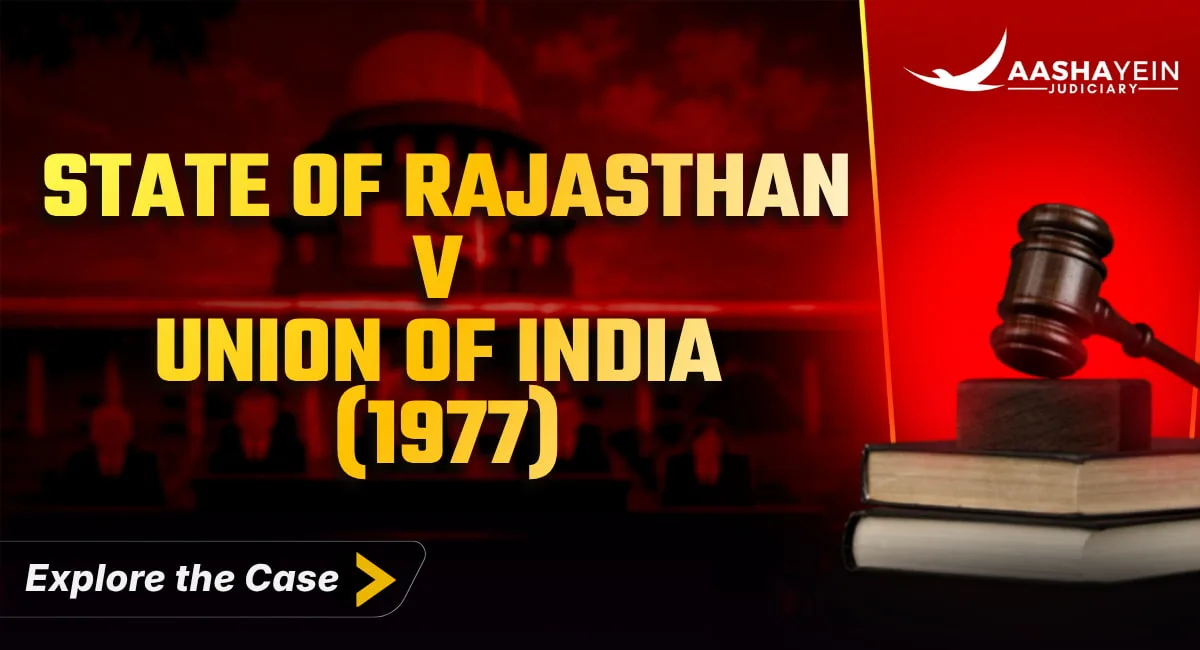
On 18 April 1977, the Union Home Minister wrote to the Chief Ministers of several States. The letter urged them to advise their Governors to dissolve their Assemblies and seek a fresh mandate. Six States went straight to the Supreme Court.
That dispute became State of Rajasthan & Ors. Etc. v. Union of India, decided on 6 May 1977. It is reported as 1977 AIR 1361, 1978 SCR (1) 1 and 1977 SCC (3) 592. The seven-judge Bench was M. Hameedullah Beg (CJ), Y.V. Chandrachud, P.N. Bhagwati, P.K. Goswami, A.C. Gupta, N.L. Untwalia and Syed Murtaza Fazalali. The case is central to the PCS J Exam, Civil Judge Exam and APO Exam when the topic is Article 356.
The political background
In early 1977, the Congress party lost power at the Centre after the Lok Sabha elections. The Janata Party formed the Union Government on 24 March 1977. Congress still governed several States, including Rajasthan, Madhya Pradesh, Punjab, Bihar, Himachal Pradesh and Orissa.
After the Home Minister's letter of 18 April, the Law Minister told All India Radio four days later that there was a clear case for dissolution.
Six States filed original suits under Article 131, asking for declarations that the letter was unconstitutional and for injunctions against dissolution. Three Punjab MLAs filed writ petitions under Article 32. They argued that dissolution would violate their rights under Articles 19(1)(f) and 31, because they would lose their salary.
The Union argued that the suits fell outside Article 131, that the questions were not for courts, and that Article 356(5) barred review of the President's satisfaction.
Questions before the Court
· Were the suits maintainable under Article 131?
· Did the letter and the proposed dissolution violate the Constitution?
· Can the President's satisfaction under Article 356 be reviewed?
· Were the MLAs' fundamental rights infringed?
· Was Parliament's approval needed before dissolution?
Read Blog: Paramvir Singh Saini v Baljit Singh (2020)
The result
By majority, the Court dismissed the suits and the writ petitions. The judges reached the result by different routes, so the opinions are not fully uniform.
· Chief Justice Beg held that the choice of when to hold elections is a matter of political expediency. Courts cannot review it unless a specific constitutional violation is shown.
· Justice Chandrachud found that the suits raised a legal question under Article 131, but held that the Proclamation remained valid for its assured two-month period.
· Justice Bhagwati held that the President's satisfaction is subjective, but can be challenged if it is mala fide, based on wholly extraneous grounds, or absent. He also found that the letter was merely advisory.
· Justices Goswami and Untwalia held that the disputes were political rather than legal, so the suits were not maintainable.
How the judges reasoned
Political and legal disputes. Article 131 covers disputes about legal rights. Justices Goswami and Untwalia saw a conflict between governments, not between the State as a legal entity and the Union.
Article 356(5) and review. Article 356(5) says the President's satisfaction "shall not be questioned in any court on any ground." Justice Bhagwati drew a line between challenging the quality of the satisfaction, which is barred, and challenging its existence, which is not. Chief Justice Beg stressed that courts cannot inquire into political wisdom, though they can step in where action is patently perverse.
Federalism. Chief Justice Beg observed that the Constitution is more unitary than federal in its working, and that national integration and planned development may justify strong central direction.
Parliament's role. Under Article 356(3), a Proclamation must be placed before Parliament. The Court held that Parliament's approval is not a condition before dissolution. Even if Parliament refuses to approve, the Proclamation operates for at least two months.
The MLAs' rights. The loss of salary was an indirect and remote consequence of dissolution. It did not infringe Article 19(1)(f) or Article 31. Justice Untwalia added that the right to allowances is a legal right, not a fundamental one.
The letter. Justice Bhagwati described it as advice with no binding force. A Chief Minister could accept or reject it.
A word of caution. Justice Untwalia said that Article 356(5) "does not imply a free licence to the Central Government to give any advice to the President."
Watch Our You Tube Video: NI Act ,1881 One Shot | Negotiable Instruments Act In One Shot
Provisions and cases to note
The judgment discusses Articles 131, 32, 74, 163, 172, 174(2)(b), 355, 356, 256, 257, 19(1)(f) and 31. Cases mentioned include Kesavananda Bharati v. State of Kerala (1973), Indira Nehru Gandhi v. Raj Narain (1976), Shamsher Singh v. State of Punjab (1975) and State of Bihar v. Union of India (1970).
A caution on the source: the page I read was long and the last part was not read, so the summary reflects the headnotes and the opinions that were available.
Using the case in an answer
The safe line is this. The President's satisfaction under Article 356 is largely shielded from review, but a narrow route remains for mala fide or wholly extraneous grounds. You can cite Bhagwati, J. for the distinction between the existence and the quality of satisfaction.
Achieve your judiciary exam goals with online judiciary preparation courses that offer structured learning, clear legal concepts, updated study materials, and targeted practice for Prelims and Mains.
FAQs
When was State of Rajasthan v. Union of India decided?
On 6 May 1977, by a seven-judge Bench of the Supreme Court.
Under which Articles did the States and MLAs approach the Court?
The States filed suits under Article 131. The Punjab MLAs filed writ petitions under Article 32.
What did the Union Home Minister's letter ask the States to do?
It urged the Chief Ministers to advise Governors to dissolve the State Assemblies under Article 174(2)(b).
Did the Court strike down the letter?
No. Justice Bhagwati described it as advisory with no binding effect, and the majority dismissed the suits.
Can the President's satisfaction under Article 356 be reviewed?
It is largely shielded by Article 356(5). Justice Bhagwati said it can be challenged if mala fide, based on wholly extraneous grounds, or absent.
Is Parliament's approval needed before dissolution?
No. The Proclamation operates for at least two months even if Parliament refuses approval.
Why were the MLAs' claims rejected?
The loss of salary was an indirect and remote consequence of dissolution.
What did Chief Justice Beg say about the nature of the Constitution?
He observed that it is more unitary than federal in its working.
Conclusion
State of Rajasthan v. Union of India is a case about limits: the limits of the Centre's advice, and the limits of the courts' review. Learn the separate opinions, because examiners like questions that ask what each judge held.
Aashayein Judiciary, with guidance from Nitesh Sir, teaches such cases through clear Judiciary Notes, PYQ analysis and Mock Test practice. Join our Online Judiciary Coaching and prepare for the PCS J Exam, Civil Judge Exam and APO Exam with confidence.

About Aashayein Team
Legal Expert
Start Your Journey
Join 50,000+ aspirants and get access to premium courses, study material, and expert guidance.
Enroll NowView All CoursesFree Resources
Newsletter
Get weekly updates on legal news, judgments, and exam tips.