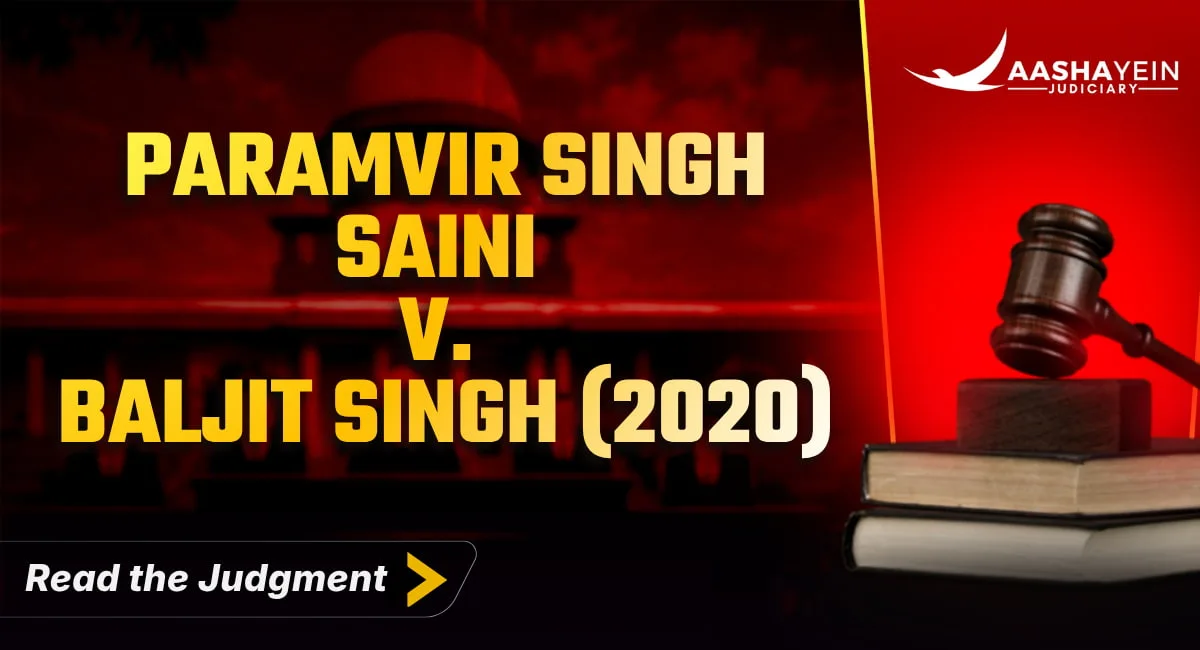
Cameras must record for at least 18 months. They must cover the lock-ups, the corridors, the main gate and the duty officer's room, but not the inside of washrooms. These are some of the directions in Paramvir Singh Saini v. Baljit Singh & Others, decided on 2 December 2020 by R.F. Nariman (author), K.M. Joseph and Aniruddha Bose, JJ. in SLP (Crl.) No. 3543 of 2020. It is reported as AIR 2021 SC 64.
The plan cites the case as (2020) 10 SCC 561. The source I could read gives AIR 2021 SC 64 and AIRONLINE 2020 SC 871, so those citations are used here.
How the case began
On 16 July 2020, a Bench of Rohinton Fali Nariman, Navin Sinha and B.R. Gavai, JJ. granted special leave and issued notice on two larger questions: whether audio-video recording of statements under Section 161 CrPC is required (the proviso to Section 161(3)), and whether CCTV cameras should be installed in police stations generally. Senior advocate Siddharth Dave was appointed amicus curiae. The order did not decide the merits of the High Court dispute.
Also Read: M. Nagaraj v Union of India (2006)
The earlier background
The Court built on Shafhi Mohammad v. State of Himachal Pradesh (2018) 5 SCC 311, where it asked the Ministry of Home Affairs to set up a Central Oversight Body to implement videography at crime scenes. It also built on D.K. Basu v. State of West Bengal (2015) 8 SCC 744, which directed CCTV in all police stations and prisons.
By 2 December 2020, fourteen States and two Union Territories had filed affidavits. The Court found most of them inadequate. They did not say how many police stations there were, where cameras were placed, whether they worked, or how long footage was kept. Nothing substantial had happened in over two and a half years.
Watch Our You Tube Video: NI Act ,1881 One Shot | Negotiable Instruments Act In One Shot
The directions
The Court grounded its directions in Article 21 and issued them in these parts:
· Fresh affidavits. The Home Secretary or Principal Secretary of each State and UT must file detailed affidavits within six weeks.
· Oversight committees. A State Level Oversight Committee (Home Secretary, Finance Secretary, DG/IG of Police and a member of the State Women's Commission) handles purchase, installation, budget and monthly reports. A District Level Oversight Committee (Divisional Commissioner, District Magistrate, Superintendent of Police and a mayor or Zilla Panchayat head) supervises maintenance, reports monthly and reviews footage for unreported human rights violations.
· Funds. State and UT Finance Departments must allocate adequate funds immediately.
· Responsibility. The Station House Officer is responsible for working cameras. If they fail, the SHO must give the district committee records of arrests and interrogations during that period.
· Placement. Cameras at all entry and exit points, the main gate, all lock-ups, corridors, the lobby or reception, verandas and outhouses, the Inspector's and Sub-Inspector's rooms, the station hall, the area in front of the compound, the area outside (not inside) washrooms, the Duty Officer's room and the rear of the station.
· Technical points. Night vision, audio and video, clear resolution. Where electricity or internet is lacking, States must provide it, including through solar or wind power. Footage must be stored for 18 months, and never less than one year if equipment cannot meet 18 months.
· Complaints. Complaints about serious injury or custodial death may go to State Human Rights Commissions under Sections 17 and 18, or to Human Rights Courts under Section 30, of the Protection of Human Rights Act, 1993. They may summon the footage.
· Central agencies. CCTV and recording equipment must be installed in the offices of the CBI, NIA, ED, NCB, DRI, SFIO and any other agency with arrest and interrogation powers.
· Public notices. Large posters in English, Hindi and the local language must say the premises are under CCTV, explain the right to complain, and say footage is kept for at least six months.
The Court called the directions "in furtherance of the fundamental rights of each citizen of India."
Exam use
This case suits answers on police accountability and custodial safety. Link it to Article 21, then D.K. Basu, then the specific directions. Note the numbers (six weeks, 18 months, minimum one year) because they are easy marks.
Prepare for judicial services exams with online judiciary preparation courses designed to build conceptual clarity, strengthen legal knowledge, and improve exam performance through expert guidance, structured classes, and practice tests.
FAQs
When was the main judgment in Paramvir Singh Saini v. Baljit Singh delivered?
On 2 December 2020.
Who wrote it?
R.F. Nariman, J., sitting with K.M. Joseph and Aniruddha Bose, JJ.
Which constitutional right underlies the directions?
Article 21.
For how long must CCTV footage be preserved?
18 months, and never less than one year where equipment cannot meet 18 months.
Where should cameras not be placed?
Inside washrooms. The area outside them must be covered.
Who is responsible for working cameras at a police station?
The Station House Officer.
Which earlier cases did the Court rely on?
Shafhi Mohammad v. State of Himachal Pradesh and D.K. Basu v. State of West Bengal.
Which central agencies were covered?
CBI, NIA, ED, NCB, DRI, SFIO and any other agency with arrest and interrogation powers.
Conclusion
Paramvir Singh Saini v. Baljit Singh shows the Court following up on its own earlier orders until they are actually carried out. The details of placement, storage and oversight are where examiners look for precision.
At Aashayein Judiciary, Nitesh Sir ensures our Judiciary Notes include such details in easy lists. Join Aashayein Judiciary for Online Judiciary Coaching, Mock Test series and PYQ practice for the Civil Judge Exam, PCS J Exam and APO Exam.

About Aashayein Team
Legal Expert
Start Your Journey
Join 50,000+ aspirants and get access to premium courses, study material, and expert guidance.
Enroll NowView All CoursesFree Resources
Newsletter
Get weekly updates on legal news, judgments, and exam tips.