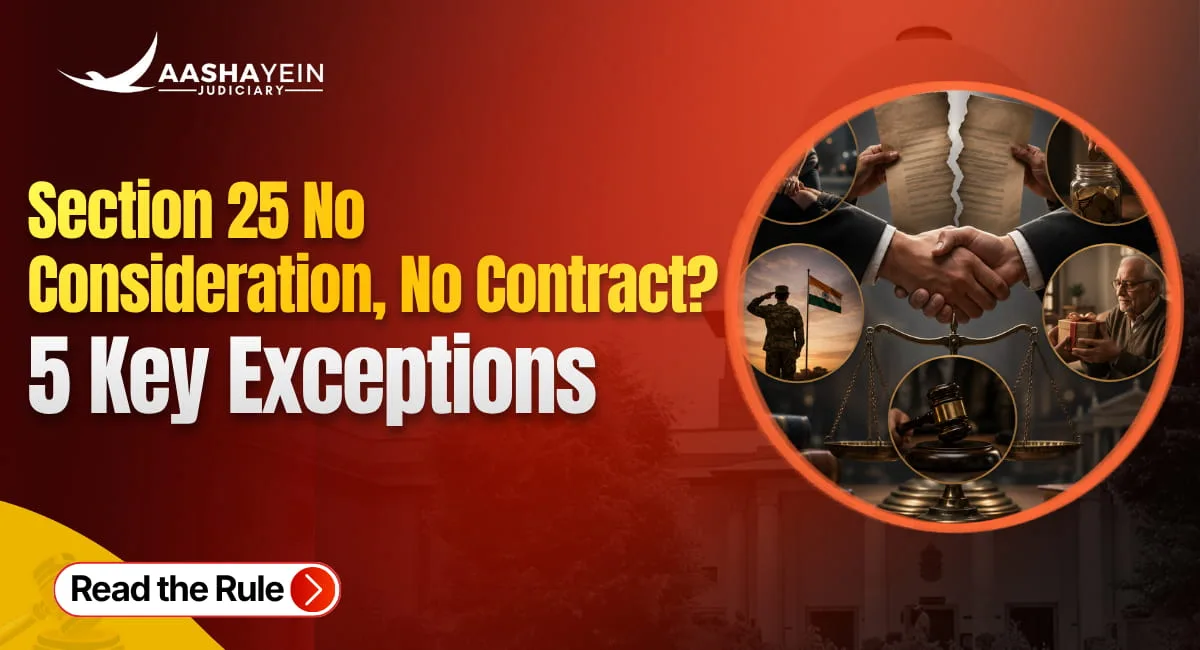
Every first-year contract law student learns the rule quickly: an agreement made without consideration is void. What gets learned less carefully is that this rule has real, statutorily recognised exceptions, and judiciary exams test the exceptions at least as often as the rule itself. Section 25 of the Indian Contract Act, 1872 lists the specific situations where a promise remains enforceable even though nothing was given in exchange for it. Getting these exceptions precise, not just the general idea but the actual conditions attached to each, is what separates a strong contract law answer from a shaky one.
The General Rule and Its Foundation
Section 2(d) of the Indian Contract Act, 1872 defines consideration around the principle of quid pro quo, something for something, requiring that at the desire of the promisor, the promisee or any other person has done or abstained from doing something, or does or abstains from doing something, or promises to do or abstain from doing something. Section 25 then states the general rule directly: an agreement made without consideration is void. This rule exists because consideration is treated as the mutuality that makes a promise legally serious enough to enforce, without it, a bare promise is generally seen as a matter of moral or social obligation rather than one the law will step in to compel.
Exception One: Natural Love and Affection
Section 25(1) carves out an exception for agreements made on account of natural love and affection between parties standing in a near relation to each other. This exception comes with two strict conditions. The agreement must be expressed in writing, and it must be registered under the law for the time being in force for the registration of documents. Both conditions are mandatory, an oral promise made purely out of love and affection, however sincere, does not qualify for this exception. In Bhiwa v. Shivaram, the Bombay High Court enforced a registered promise made out of natural love and affection between two brothers, even though the brothers were not on particularly good terms with each other at the time, illustrating that the exception turns on the near relation between the parties and the formal requirements being met, not on the actual emotional warmth of the relationship in practice.
Read Blog: The Hearsay Rule prevents the admission of certain out-of-court statements, but the law provides key exceptions where such evidence may be admissible. Learn the Hearsay Rule and its key exception to strengthen your understanding of Evidence Law and Judiciary Exams.
Exception Two: Compensation for Past Voluntary Services
Section 25(2) validates a promise to compensate a person who has already voluntarily done something for the promisor. This exception has its own conditions worth remembering precisely. The service must actually have been rendered voluntarily, meaning not at the promisor's request at the time it was performed, since a service performed at the promisor's request would already constitute ordinary consideration under the general rule. The promisor must have been in existence at the time the service was performed, and the promisor must genuinely have intended to compensate the person for that service when the later promise is made. A commonly used illustration involves a person who supports another's infant child voluntarily, without being asked to do so, after which the parent later promises to reimburse the expenses incurred, this later promise is enforceable even though nothing was given in exchange for it at the time it was made.
Exception Three: Promise to Pay a Time-Barred Debt
Section 25(3) validates a written and signed promise to pay, wholly or in part, a debt that could no longer be legally recovered because the limitation period for enforcing it has expired under the Limitation Act. The signature must be that of the debtor or the debtor's duly authorised agent. This exception reflects the idea that limitation law bars the remedy for recovering the debt, it does not extinguish the underlying moral or factual obligation itself, so a fresh, deliberate written promise to honour that obligation is treated as sufficiently serious to be enforced on its own terms, without needing any fresh consideration to support it.
Exception Four: Agency
As discussed in the law of agency itself, Section 185 of the Act separately provides that no consideration is necessary to create an agency. This exception sits alongside, though is sometimes listed as a distinct instance of, the broader principle that certain relationships of trust and representation do not require an exchange of value to come into legal existence.
Exception Five: Completed Gifts
Explanation 1 to Section 25 clarifies that nothing in the section affects the validity, as between the donor and the donee, of any gift actually made. Where a donor makes a gift and the donee accepts it, the transaction is treated as valid and enforceable notwithstanding the total absence of consideration, since a gift by its very nature involves no consideration flowing back to the donor at all, and the law does not treat this as a defect once the gift has actually been completed and accepted.
What About Inadequate Consideration
A closely related but distinct point, frequently tested alongside the exceptions themselves, concerns inadequate consideration rather than absent consideration. Section 25's Explanation 2 clarifies that an agreement is not void merely because the consideration is inadequate, though the inadequacy of consideration may be taken into account by a court when assessing whether the consenting party's consent was actually freely given. The Act's own illustrations make this distinction sharply, an agreement to sell a horse worth Rs. 1,000 for just Rs. 10 remains a valid contract if consent was freely given, notwithstanding the glaring inadequacy of the price, but if the party who agreed to the low price disputes that their consent was freely given, the court is entitled to weigh that inadequacy as evidence relevant to assessing whether fraud, undue influence, or a similar vitiating factor was actually present.
Frequently Asked Questions
Q1. What are the five recognised exceptions to the rule of no consideration, no contract under Section 25?
Natural love and affection, compensation for past voluntary services, a promise to pay a time-barred debt, creation of an agency, and completed gifts.
Q2. What two conditions must be met for the natural love and affection exception to apply?
The agreement must be in writing and must be registered under the applicable law for registration of documents, in addition to the parties standing in a near relation to each other.
Q3. What did Bhiwa v. Shivaram establish?
That a registered promise made out of natural love and affection between two brothers was enforceable even though the brothers were not on good terms, showing the exception turns on formal requirements and near relation, not actual emotional warmth.
Q4. What conditions apply to the past voluntary services exception under Section 25(2)?
The service must have been rendered voluntarily and not at the promisor's request, the promisor must have existed at the time, and the promisor must genuinely intend to compensate for that specific past service.
Q5. What does Section 25(3) require for a promise to pay a time-barred debt to be enforceable?
A written promise, signed by the debtor or their authorised agent, to pay the debt wholly or in part, despite the limitation period for recovering it having expired.
Q6. Is consideration necessary to create an agency?
No. Section 185 of the Indian Contract Act expressly states that no consideration is necessary to create an agency.
Q7. Does inadequate consideration make an agreement void?
No. Explanation 2 to Section 25 clarifies that inadequacy of consideration does not void an agreement, though a court may consider it when assessing whether consent was freely given.
Q8. Does the completed gift exception require the gift to be in a particular form?
Explanation 1 to Section 25 validates a gift as between donor and donee once it is actually made and accepted, without imposing the same written and registered requirement that applies to the natural love and affection exception.
Conclusion
Section 25 is short, but it rewards candidates who can state each exception with its exact statutory conditions rather than a vague general sense of the category. Nitesh Sir's contract law sessions at Aashayein Judiciary drill these exceptions through problem questions built around the Act's own illustrations, since mains examiners frequently borrow directly from those illustrations when framing fact patterns. If Section 25's exceptions still blur together in your notes, structured judiciary coaching with targeted PYQ practice can help you state each one precisely under exam pressure.Prepare smarter with the Best Online Judiciary Coaching featuring expert-led classes, concept-focused learning, updated study material, mock tests, and strategic guidance for Judiciary Exam Preparation.

About Aashayein Team
Legal Expert
Start Your Journey
Join 50,000+ aspirants and get access to premium courses, study material, and expert guidance.
Enroll NowView All CoursesFree Resources
Newsletter
Get weekly updates on legal news, judgments, and exam tips.
-5.webp)