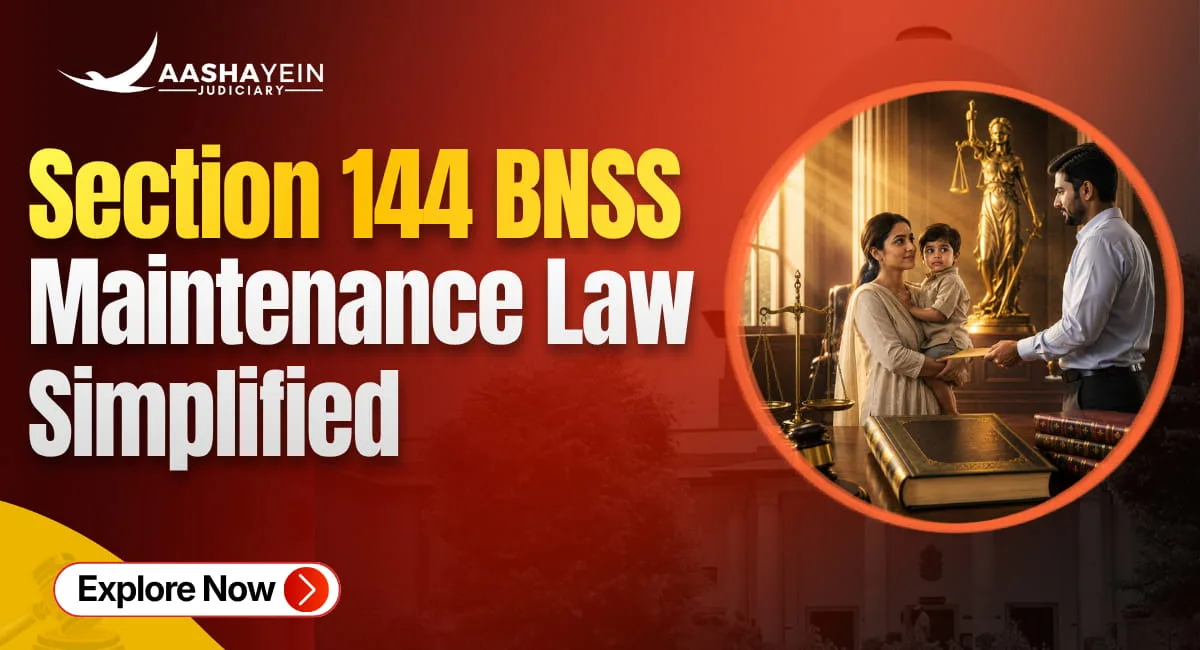
Maintenance law is one of the most practical and frequently tested areas in judiciary exams, since it touches both family law and criminal procedure. With the Bharatiya Nagarik Suraksha Sanhita, 2023 replacing the Code of Criminal Procedure, 1973 from 1 July 2024, the well known Section 125 CrPC has become Section 144 BNSS. In this blog, we explain who can claim maintenance, how the procedure works, and what has changed with the new code.
What Is Maintenance Under Section 144 BNSS
Section 144 BNSS establishes the duty of a person with sufficient means to maintain and support certain dependent family members who are unable to maintain themselves. It allows a Judicial Magistrate of the First Class to direct such a person to make a monthly allowance for maintenance, at a rate the Magistrate considers appropriate, once neglect or refusal to maintain is proved.
This provision is a secular, welfare oriented remedy, meaning it applies to persons of all religions, Hindu, Muslim, Christian, or Parsi, and operates independently of personal law. Its core purpose is to prevent destitution and vagrancy among dependent family members who have no other means of support.
Who Can Claim Maintenance
• A wife who is unable to maintain herself, including a divorced woman who has not remarried.
• Legitimate or illegitimate minor children who are unable to maintain themselves, whether married or not.
• Legitimate or illegitimate children, other than a married daughter, who have attained majority but are unable to maintain themselves due to a physical or mental abnormality or injury.
• A father or mother who is unable to maintain himself or herself.
Where and How to File an Application
An application for maintenance is filed before a Judicial Magistrate of the First Class. It can be filed in the area where the claimant resides, where the person against whom maintenance is claimed resides, or where that person last resided with the claimant. This flexibility is particularly important for wives who may have moved to their parental home after separation, since it allows them to file in a location convenient to them rather than being forced to travel to wherever the husband currently resides.
The Magistrate, upon proof of neglect or refusal to maintain, can order a monthly allowance. The amount is not fixed by any formula, it is determined at the Magistrate's discretion, based on factors such as the standard of living the claimant is accustomed to, the income and assets of the person against whom the claim is made, and the reasonable needs of the claimant.
A comprehensive Judiciary Exam Preparation Course provides everything you need to succeed in the Judicial Services Examination. From conceptual clarity and updated study material to live classes, mock tests, and personalized mentorship, the course is designed to help you prepare effectively and perform confidently in the prelims, mains, and interview stages.
Interim Maintenance
Recognising that maintenance proceedings can take time to conclude, the law allows courts to grant interim maintenance while the main application is still pending. This ensures that a dependent claimant is not left without any support during the often lengthy course of litigation.
What Changed With the Shift From CrPC to BNSS
Section 144 BNSS is essentially a re-enactment of Section 125 CrPC, carrying forward the same fundamental principles and eligible categories of claimants. The core intent, protecting the financial rights of dependent wives, children, and parents, remains unchanged. What the transition brings is updated procedural clarity and continuity, rather than a substantive overhaul of who can claim maintenance or on what grounds.
Because the substance of the provision remains so closely aligned with the earlier Section 125 CrPC, the large body of Supreme Court precedent developed over decades under that section, covering issues like the meaning of unable to maintain herself, the treatment of second wives, and the interplay between maintenance and other personal law remedies, continues to remain relevant and persuasive under Section 144 BNSS.
As with other provisions transitioning from the CrPC to the BNSS, cases and applications filed before 1 July 2024 generally continue under the earlier CrPC framework, while new applications filed on or after that date fall under the BNSS.
Maintenance and Personal Law: An Important Point
Since Section 144 BNSS operates as a secular provision, it exists independently of and in addition to whatever maintenance remedies a person might have under their own personal law, such as the Hindu Marriage Act or the Muslim Women (Protection of Rights on Divorce) Act, 1986. This overlapping framework has been the subject of significant judicial interpretation over the years, most famously in the context of divorced Muslim women, where courts have had to work out how Section 125 CrPC style maintenance interacts with obligations under personal law.
Comprehensive Judicial Services Notes cover major laws, procedural subjects, and important case laws frequently asked in judicial service examinations. They serve as a reliable resource for both prelims and mains preparation.
Frequently Asked Questions
Q: What is Section 144 BNSS?
A: Section 144 of the Bharatiya Nagarik Suraksha Sanhita, 2023 provides for maintenance of a wife, children, and parents who are unable to maintain themselves, replacing the earlier Section 125 CrPC.
Q: Who can claim maintenance under this provision?
A: A wife unable to maintain herself (including a divorced woman who has not remarried), minor children unable to maintain themselves, major children unable to maintain themselves due to disability, and parents unable to maintain themselves.
Q: Where should a maintenance application be filed?
A: Before a Judicial Magistrate of the First Class, in the area where the claimant resides, where the respondent resides, or where the respondent last resided with the claimant.
Q: Is there a fixed formula for calculating the maintenance amount?
A: No. The amount is determined at the Magistrate's discretion, considering the claimant's standard of living, the respondent's income and assets, and the claimant's reasonable needs.
Q: Can interim maintenance be granted?
A: Yes. Courts can grant interim maintenance while the main application is pending, to ensure the claimant is not left without support during litigation.
Q: Does Section 144 BNSS apply to all religions?
A: Yes. It is a secular provision that applies to persons of all religions, operating independently of personal law.
Q: When did Section 144 BNSS come into effect?
A: It came into effect on 1 July 2024, when the Bharatiya Nagarik Suraksha Sanhita, 2023 replaced the Code of Criminal Procedure, 1973.
Q: Why is this topic important for judiciary exams?
A: It combines family law and criminal procedure, is frequently tested for eligibility criteria and procedural details, and connects naturally to important case law on maintenance across personal laws.
Conclusion
Maintenance under Section 144 BNSS continues a decades old tradition of protecting dependent family members from destitution, now carried forward under a new numbering system. For judiciary aspirants, the key is to be comfortable moving between the old Section 125 CrPC references found in older case law and the new Section 144 BNSS numbering used going forward.
Prepare for the Judicial Services Examination from anywhere with Online Judiciary Exam Coaching. Get access to live and recorded classes, expert mentorship, comprehensive study material, mock tests, and answer-writing practice—all designed to help you build strong legal concepts and succeed in every stage of the Judiciary Exam.

About Aashayein Team
Legal Expert
Start Your Journey
Join 50,000+ aspirants and get access to premium courses, study material, and expert guidance.
Enroll NowView All CoursesFree Resources
Newsletter
Get weekly updates on legal news, judgments, and exam tips.