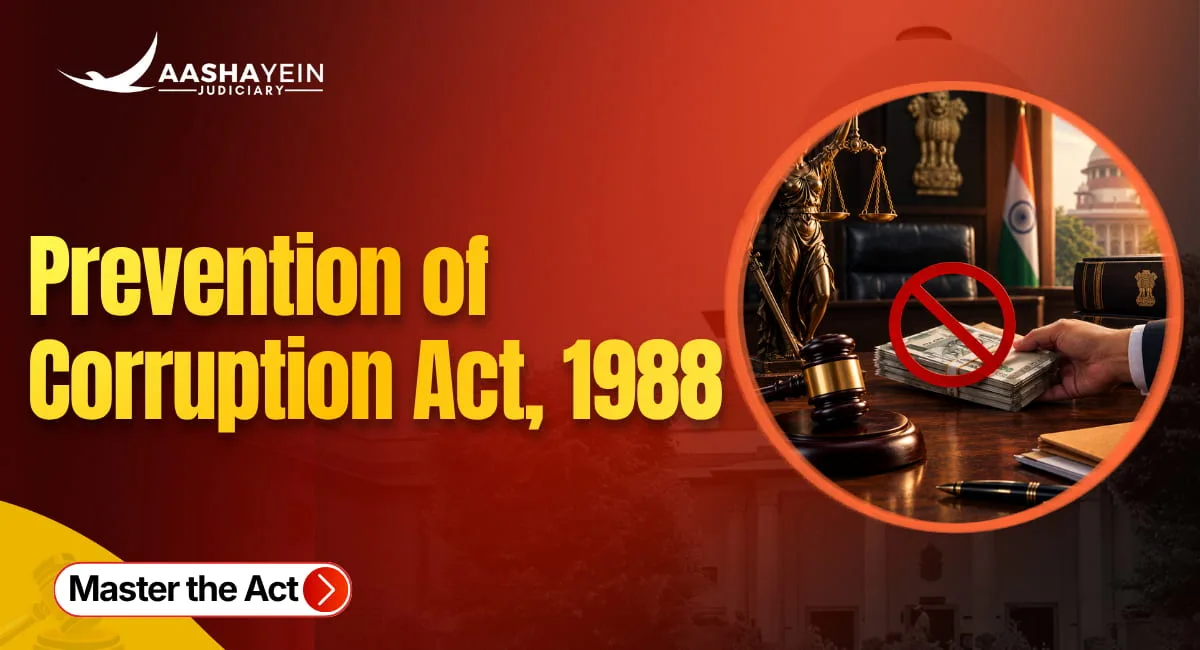
Corruption in public office was first addressed in colonial India through the Prevention of Corruption Act, 1947. India replaced it with the Prevention of Corruption Act, 1988 (PC Act), and then made substantial amendments to the Act in 2018. Today, the 2018-amended PC Act is the primary statute governing criminal liability of public servants for corruption. For any APO exam or Civil Judge exam candidate, understanding what the PC Act does, what it prohibits, and how prosecutions under it work is essential.
Who Is a 'Public Servant' Under the PC Act?
Section 2(c) of the PC Act defines public servant to include every official in central and state government service, employees of public sector undertakings, members of Parliament and state legislatures, judges, officers of courts, armed forces, and persons in the service of local authorities. The definition is wide — it covers more categories than the definition in Section 21 of the Indian Penal Code (now BNS).
The 2018 Amendment: Conceptual Shift
The Prevention of Corruption (Amendment) Act, 2018 made several significant changes:
● Replaced 'illegal gratification' with 'undue advantage' — the new term is broader. Undue advantage means any gratification other than the legal remuneration of the public servant.
● Added bribe-giving as an offence — under the old Act, only the taker could be prosecuted. The 2018 amendment added Section 8, which makes giving a bribe to a public servant an offence punishable with imprisonment.
● Section 17A was added — prior approval of the appropriate government is now required before a police officer can conduct a preliminary inquiry or register a FIR against a public servant for an offence alleged to have been committed while discharging their official duties.
Key Offences Under the PC Act
Section 7: Offence of Bribery (Taking)
Section 7 makes it an offence for a public servant to obtain or accept, or agree to obtain or accept, any undue advantage for themselves or for any other person, as a motive or reward for doing or forbearing to do any official act. The offence is punishable with imprisonment from 3 to 7 years and fine.
The 2018 amendment removed the requirement of proving 'corrupt or illegal motive' — it is sufficient to prove that the public servant obtained or accepted an undue advantage in relation to their official act.
Also Check: Hindu Adoptions and Maintenance Act, 1956
Section 8: Offence of Bribery (Giving)
Added by the 2018 amendment, Section 8 makes the person who gives, promises, or offers a bribe to a public servant liable to punishment with imprisonment from 3 to 7 years and fine. Exception: if the bribe-giver was compelled to pay and reports the matter to law enforcement within 7 days, they may be exempt from prosecution.
Section 11: Public Servant Obtaining Undue Advantage Without Consideration
Section 11 covers a public servant obtaining or accepting any undue advantage for themselves or for another person from someone over whom they have official authority or dealings — even without any specific agreement. This covers cases where a public servant accepts 'gifts' from persons over whom they exercise powers.
Section 13: Criminal Misconduct
Section 13 covers criminal misconduct by a public servant. It includes: (a) dishonestly or fraudulently misappropriating or allowing misappropriation of property entrusted to them or under their control; and (b) possessing or having under their control property disproportionate to their known sources of income and not satisfactorily accounted for.
The disproportionate assets offence (Section 13(1)(b)) is one of the most commonly prosecuted offences under the PC Act.
How Trap Cases Work
Trap cases — where anti-corruption agencies arrange for a person to offer a bribe to a public servant and catch the servant in the act — are a common method of investigation. The typical procedure:
● A complainant approaches the Anti-Corruption Bureau or CBI, alleging that a public servant has demanded a bribe.
● The currency notes to be used as bribe are treated with phenolphthalein powder. The serial numbers are noted.
● The complainant pays the bribe in the presence of witnesses, and the trap team moves in immediately to apprehend the suspect.
● A test is conducted — hands dipped in sodium carbonate solution turn pink, confirming contact with the treated notes.
The shadow witness (panchanama witness) and the mediator's testimony are critical in trap cases. The Supreme Court has cautioned that independent witnesses (not from the police) must be present for the evidence to be credible.
Sanction for Prosecution: Section 19
Section 19 of the PC Act requires prior sanction from the appropriate government before a court can take cognizance of any offence under Sections 7, 11, 13, and 15 alleged against a public servant who is employed or was employed at the time of the alleged offence. Without the sanction, the prosecution cannot proceed.
Section 17A (added in 2018) goes further: even before registering an FIR or initiating a preliminary inquiry, police must obtain prior approval of the appropriate government where the alleged offence relates to a recommendation made or decision taken by a public servant in the discharge of their official functions.
Special Courts Under the PC Act
Section 3 of the PC Act provides for the Central Government or State Governments to appoint Special Judges for the trial of offences under the Act. The Special Judge takes cognizance without the accused being committed to them for trial. Cases are tried as warrant cases, applying CrPC / BNSS procedures.
Section 4: Every offence specified under Sections 7, 10, 11, 12, and 13 shall be tried by the Special Judge.
Exam Relevance: Key Sections to Know
For the APO exam and Civil Judge exam:
● Section 2(c) — definition of public servant (wider than BNS).
● Section 7 — taking bribe (3-7 years). Undue advantage concept.
● Section 8 — giving bribe (2018 addition, 3-7 years). Exception for compelled bribe.
● Section 13(1)(b) — disproportionate assets.
● Section 19 — sanction for prosecution.
● Section 17A — prior approval before FIR (2018 addition).
● Section 3 and 4 — Special Judges and procedure.
Build a strong foundation with Best Online Judiciary Coaching featuring expert-led classes, concept-focused learning, updated study material, PYQs, and structured guidance for effective Judiciary Exam preparation.
Frequently Asked Questions
Q1. What is the Prevention of Corruption Act, 1988?
The PC Act is India's primary statute criminalising bribery and corruption by public servants. It has been significantly amended in 2018 to add bribe-giving as an offence, widen the definition to 'undue advantage', and add a prior-approval requirement before FIRs against public servants.
Q2. What is 'undue advantage' under the PC Act?
'Undue advantage' replaces the older term 'illegal gratification'. It means any gratification other than legal remuneration. It can be money, a gift, a favour, or any other benefit.
Q3. Is giving a bribe also an offence under the PC Act?
Yes, after the 2018 amendment. Section 8 makes bribe-giving punishable with 3-7 years imprisonment. Exception: if the bribe was given under compulsion and the person reports it to law enforcement within 7 days of giving it, they may escape prosecution.
Q4. What is the disproportionate assets offence?
Section 13(1)(b) makes it an offence for a public servant to possess assets (in their own name or in the name of a family member) disproportionate to their known sources of income, which cannot be satisfactorily accounted for. The burden of proof on the public servant to explain the disproportion is significant.
Q5. What is Section 19 sanction?
Section 19 requires prior sanction from the competent government authority before a court can take cognizance of an offence under Sections 7, 11, 13, or 15 of the PC Act. Without sanction, the case cannot proceed. The competent authority varies depending on which government employs the accused.
Q6. What is Section 17A?
Added by the 2018 amendment, Section 17A requires prior approval from the appropriate government before police can even initiate a preliminary inquiry or register an FIR against a public servant for an offence alleged to have been committed while discharging official duties.
Q7. How does a trap case work?
A complainant reports demand of bribe. Currency notes are treated with phenolphthalein powder and serial numbers noted. The complainant pays the bribe in the presence of witnesses. The trap team immediately moves in. A pink reaction test (sodium carbonate solution) confirms contact with the treated currency. The public servant is arrested.
Q8. What are Special Judges under the PC Act?
The PC Act provides for Special Judges appointed by the Central or State Government to try offences under the Act. Special Judges take cognizance directly without committal. The trial follows the CrPC/BNSS procedure for warrant cases, but is heard in a dedicated special court.
Q9. Who is covered under the definition of 'public servant' in the PC Act?
The definition in Section 2(c) is wider than the IPC/BNS definition. It covers government employees, employees of public sector undertakings, Members of Parliament and state legislatures, judges, court officers, armed forces members, and persons serving local authorities, among others.
Q10. Is the PC Act applicable to private sector corruption?
The PC Act applies only to public servants. Private sector corruption is addressed through other laws — the Prevention of Money Laundering Act, 2002 (PMLA) in some contexts, and the IPC/BNS for criminal breach of trust and cheating.
Conclusion
The Prevention of Corruption Act, 1988 as amended in 2018 gives India a comprehensive framework for fighting public corruption — from bribe-taking and bribe-giving to criminal misconduct and disproportionate assets. The 2018 amendments significantly tightened the law: giving a bribe is now a crime, and even initiating an investigation against a public servant requires prior government approval. For APO exam and Civil Judge exam candidates, this statute is among the most important special laws to know in detail.
Nitesh Sir at Aashayein Judiciary covers the PC Act, anti-corruption law, and special legislation as part of structured APO exam and PCS J exam preparation. Explore our Judiciary Notes, Online Judiciary Coaching, and Mock Test series to prepare with depth on every examinable statute.

About Aashayein Team
Legal Expert
Start Your Journey
Join 50,000+ aspirants and get access to premium courses, study material, and expert guidance.
Enroll NowView All CoursesFree Resources
Newsletter
Get weekly updates on legal news, judgments, and exam tips.