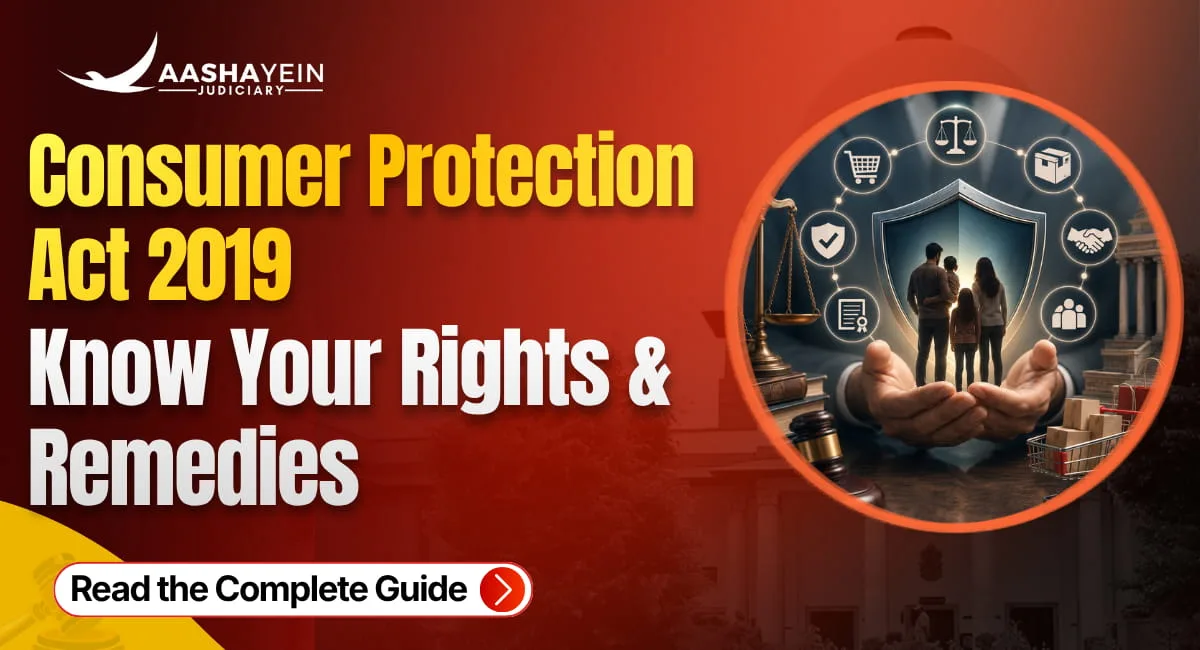
You buy a refrigerator that stops working after two weeks. The seller refuses to repair it. You order food online and receive something that makes you sick. A hospital charges you for a treatment you did not receive. All of these are situations where the Consumer Protection Act, 2019 steps in.
The Act replaced the Consumer Protection Act, 1986. The older law had served for three decades but could not address the explosion of e-commerce, telemarketing, and digital services. The 2019 Act modernised consumer protection in India and created faster, stronger remedies for consumers.
The Six Consumer Rights Under the 2019 Act
Section 2(9) of the Consumer Protection Act, 2019 lists six consumer rights. These are the foundation of the entire statute and are tested frequently in exams.
The right to be protected against marketing of hazardous goods and services. The right to be informed about quality, quantity, price, and standard of goods and services. The right to be assured access to a variety of goods and services at competitive prices. The right to be heard and to seek redressal against unfair practices. The right to seek redressal against unfair trade practices. The right to consumer education.
A useful mnemonic: Protection, Information, Choice, Hearing, Redressal, Education.
Who Is a Consumer? Section 2(7)
Section 2(7) defines a consumer as a person who buys goods or hires services for consideration, and includes the user of those goods or services with the buyer's approval. Crucially, persons who buy for resale or commercial purposes are excluded.
The 2019 Act clarified that buying goods or services online is covered. A person who buys on Amazon, Flipkart, Swiggy, or any e-commerce platform is a "consumer" entitled to protection under this Act.
What about free services? If no consideration is paid (no price, no fee), the person is generally not a consumer under the Act. But a person who receives services as part of a larger paid transaction — for example, free delivery included in a purchase — is still covered.
Read Also: Companies Act 2013: Key Provisions for Judiciary & APO
Defect, Deficiency, and Unfair Trade Practice
Three concepts appear in almost every consumer law question.
"Defect" under Section 2(10) means any fault, imperfection, or shortcoming in quality, quantity, potency, purity, or standard of goods that is required to be maintained. If a product does not match the promised specification, there is a defect.
"Deficiency" under Section 2(11) is the fault, imperfection, shortcoming, or inadequacy in the quality, nature, or manner of performance that is required to be maintained in relation to a service. Poor quality of service, failure to deliver on time, or medical negligence can all constitute deficiency.
"Unfair trade practice" under Section 2(47) includes misleading advertisements, false representations about product standards, refusing to take back defective goods, and offering contest prizes with the intent never to provide them.
The Three-Tier Consumer Forum Structure
Disputes are resolved through a three-tier quasi-judicial system. Jurisdiction is based on the value of the claim.
District Consumer Disputes Redressal Commission
The District Commission (formerly District Forum) handles complaints where the value of goods or services and the compensation claimed does not exceed Rs. 1 crore. It is the first port of call for most consumers. Appeals from the District Commission go to the State Commission.
State Consumer Disputes Redressal Commission
The State Commission handles complaints where the claim value exceeds Rs. 1 crore but does not exceed Rs. 10 crore. It also hears appeals from District Commissions. Appeals from State Commissions go to the National Commission.
National Consumer Disputes Redressal Commission (NCDRC)
The National Commission sits in New Delhi and handles complaints where the claim value exceeds Rs. 10 crore. It also hears appeals from State Commissions. Appeals from NCDRC go to the Supreme Court of India.
These monetary limits were revised and increased significantly by the 2019 Act compared to the 1986 Act. For exam purposes, remember: District = up to Rs. 1 crore, State = Rs. 1-10 crore, National = above Rs. 10 crore.
Product Liability: A New Chapter
Chapter VI of the Consumer Protection Act, 2019 introduced product liability — an entirely new concept in Indian consumer law. Under Section 82, a product manufacturer, service provider, or product seller can be held liable for harm caused by a defective product or deficient service.
Liability can arise from manufacturing defect, design defect, or failure to warn consumers about known risks. This provision is significant because earlier, a consumer had to prove negligence on the part of the manufacturer. Under the 2019 Act, strict liability principles apply in certain situations.
Product liability is directly applicable in pharmaceutical product cases, food safety cases, and defective vehicle cases — areas where judiciary aspirants should be alert.
E-Commerce and Direct Selling
The 2019 Act specifically covers e-commerce platforms and direct selling. Section 2(16) defines "e-commerce" as buying and selling over digital or electronic networks. E-commerce entities must display relevant information about sellers, prices, delivery terms, return policies, and grievance officers prominently.
The Central Consumer Protection Authority (CCPA), created under Section 10, is empowered to take suo motu action against unfair trade practices in e-commerce, recall dangerous products, and issue guidelines for the protection of consumer rights. It is headquartered in New Delhi.
Watch Our YouTube Video: Revise the CPC 1908 in one focused session with key concepts, important provisions, and exam-oriented insights.
CPC in One Shot | Civil Procedure Code, 1908
Filing a Consumer Complaint
A complaint can be filed by: the consumer directly; any recognised consumer association; the Central or State government; or a group of consumers having the same interest. The complaint must be filed within two years from the date on which the cause of action arises. The Commission can condone delay for sufficient cause.
The 2019 Act introduced online filing of complaints — a significant change that made access to consumer justice easier. Complaints can be filed through the consumer online portal (consumerhelpline.gov.in or edaakhil.nic.in).
Mediation is also encouraged under the 2019 Act. Consumer Commissions can refer matters to mediation where the parties agree. If mediation succeeds, the settlement is recorded and becomes binding.
Penalties for Misleading Advertisements
Section 21 gives the CCPA power to act against misleading advertisements. A manufacturer or endorser of a misleading advertisement can be fined up to Rs. 10 lakh for a first offence and up to Rs. 50 lakh for repeat offences. The endorser — including celebrities — can be prohibited from endorsing that brand for up to 3 years.
This provision generated significant public interest when it was enacted. Exam questions often ask: "Can a celebrity endorser be held liable under the Consumer Protection Act, 2019 for a misleading advertisement?" The answer is yes, under Section 21 read with the CCPA regulations.
Exam Relevance for Judiciary and APO Aspirants
Consumer law is part of civil law syllabi for APO and judiciary exams in several states. Key areas to prepare: the three-tier forum structure and their monetary jurisdiction, definition of consumer (Section 2(7)), the six rights under Section 2(9), product liability under Chapter VI, CCPA powers, and the limitation period for filing complaints.
A standard mains question: "Explain the consumer redressal mechanism under the Consumer Protection Act, 2019 with reference to jurisdiction of each forum." Cover all three levels, the value thresholds, and the appeal structure in clear prose.
Frequently Asked Questions
Q1. What replaced the Consumer Protection Act, 1986?
The Consumer Protection Act, 2019 replaced the 1986 Act. It came into force on July 20, 2020.
Q2. What is the definition of consumer under Section 2(7)?
A consumer is a person who buys goods or hires services for consideration. The definition excludes persons who buy for resale or commercial purposes. Online buyers are explicitly included.
Q3. What are the monetary limits of each Consumer Commission?
District Commission: claims up to Rs. 1 crore. State Commission: claims between Rs. 1 crore and Rs. 10 crore. National Commission: claims above Rs. 10 crore.
Q4. What is product liability under the 2019 Act?
Product liability (Chapter VI) makes manufacturers, sellers, and service providers liable for harm caused by defective products or deficient services, even without proof of negligence in certain cases. Manufacturing defect, design defect, and failure to warn are the three heads of liability.
Q5. What is the limitation period for filing a consumer complaint?
Two years from the date on which the cause of action arises. Delay can be condoned for sufficient cause.
Q6. What is the CCPA?
The Central Consumer Protection Authority, created under Section 10, is a regulatory body with power to investigate unfair trade practices, recall products, and act against misleading advertisements. It can impose fines on manufacturers and endorsers.
Q7. Can a celebrity be penalised for endorsing a misleading advertisement?
Yes. Section 21 allows the CCPA to impose fines on endorsers and prohibit them from endorsing the advertiser for up to 3 years in case of repeat violation.
Q8. What is e-commerce under the Consumer Protection Act, 2019?
Section 2(16) defines e-commerce as buying and selling of goods or services including digital products over digital or electronic networks.
Q9. Who can file a consumer complaint?
The consumer, a recognised consumer association, the Central or State government on behalf of consumers, or a group of consumers with the same interest can file a complaint.
Q10. What are the six consumer rights under Section 2(9)?
Right to protection, right to information, right to choice, right to be heard, right to seek redressal, and right to consumer education.
Conclusion
The Consumer Protection Act, 2019 is a statute every APO and judiciary aspirant must understand — not just the black letter law, but the logic behind the three-tier structure, the product liability provisions, and the CCPA. It is a practical law that touches daily life, and examiners expect both conceptual clarity and the ability to apply provisions to problems.
Aashayein Judiciary, guided by Nitesh Sir, covers consumer law thoroughly in its APO and Civil Judge exam preparation material. From section-wise notes to mock tests with consumer law problems, we prepare you to handle every angle of this subject. Your preparation should be as strong as the law itself. Join Aashayein Judiciary and start building that strength today.

About Aashayein Team
Legal Expert
Start Your Journey
Join 50,000+ aspirants and get access to premium courses, study material, and expert guidance.
Enroll NowView All CoursesFree Resources
Newsletter
Get weekly updates on legal news, judgments, and exam tips.