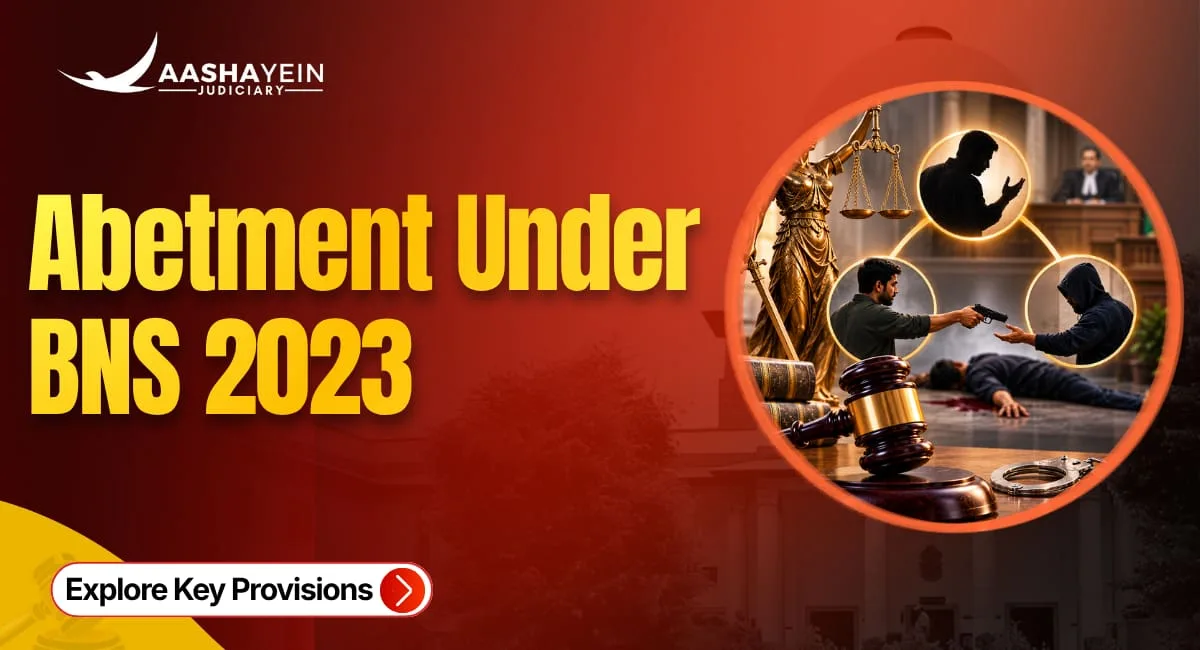
Someone buys a knife, hands it to a friend and says nothing more. The friend uses it to kill a third person. Is the man who handed over the knife also guilty? The law of abetment answers that, and it is a regular topic in the Civil Judge Exam, PCS J Exam and APO Exam.
Abetment is explained here through Sections 107 to 120 of the Indian Penal Code. The same ideas and cases carry into Sections 45 to 60 of the Bharatiya Nyaya Sanhita, 2023. Keep your BNS Bare Act open and match each section number while revising.
What abetment means
To abet means to aid, assist, command, procure, counsel, encourage or set another person to commit something. The article cites Sanju v State of Madhya Pradesh for this meaning. Abetment needs at least two people, the abettor and the person who does the act.
Under Section 107 IPC, a person abets the doing of a thing in three ways:
· By instigating a person to do it.
· By engaging with one or more persons in a conspiracy for doing it, if an act or illegal omission happens in pursuance of that conspiracy.
· By intentionally aiding the doing of it by an act or illegal omission.
The offence turns on the intention of the abettor and not on what the other person finally does. Mens rea is essential. Negligence or carelessness is not abetment. Words said in anger, without any intention to cause the result, are not instigation.
The three kinds of abetment
Abetment by instigation
To instigate is to urge forward, provoke, incite or encourage. It need not be in words. The article gives two examples: a gesture indicating beating, and an arrested person offering money to the constable who arrests him, which can be instigation to take a bribe. Whether there was instigation is a question of fact in each case.
Mere permission does not amount to instigation. Wilful misrepresentation, or wilful concealment of a material fact that a person is bound to disclose, can also be instigation, as Explanation 1 to Section 107 says.
Courts have dealt with workplace and family situations. In Madan Mohan Singh v State of Gujarat, a superior officer rebuked a driver and threatened suspension, and the driver later died by suicide. The Supreme Court said the accused must have instigated, conspired or aided in some way. It added that if a superior's remarks about a subordinate's work counted as abetment of suicide, it would become almost impossible for officers to do their job. The article records that no straitjacket formula exists, and that where an accused has created circumstances leaving a person no option but to die, instigation may be inferred.
Also Check: Charge Under TPA: Sections 100 and 101 Explained
Abetment by conspiracy
Here, the abettor engages with one or more persons in a conspiracy, and an act or illegal omission takes place in pursuance of it. This is different from the separate offence of criminal conspiracy, which is covered in the next blog in the series.
Abetment by intentional aid
The abettor intentionally helps by an act or illegal omission. The example: a security guard who deliberately leaves the keys at the door so that thieves can enter. Merely being present at the scene is not aiding. Passive help can also count, as where an accused found with a spear at the scene of a fight was held liable for the injuries, whether or not he used it.
Not stopping an offence is generally not enough. But where a person is in direct control of another's conduct and fails to stop him, that can be abetment. The article cites Tuck v Robson, where a publican who made no effort to get customers to leave after closing time was held to have aided the offence.

Who is an abettor
Section 108 describes the abettor, and its explanations make four things clear, as the article sets them out:
· A private person who instigates a public servant to commit an illegal omission of duty abets the offence, though the private person could not have committed it himself.
· The act abetted need not be committed. Abetment is complete even if the person refuses, fails, or does it and the expected result does not follow.
· The person abetted need not have a guilty intention.
· When the abetment of an offence is an offence, the abetment of that abetment is also an offence.
The article also notes an innocent agent. If a person uses an innocent agent, such as a child or a person without mens rea, to commit an offence, he is the principal offender. Its example is a mother who sent her daughter to give her father a powder that was poison. The mother was held to be the culprit, since the daughter lacked mens rea.
Punishment: the different situations
The article explains that three situations can arise after abetment. The punishments differ in each.
· The offence is committed in consequence of the abetment: Sections 109 and 110. Under Section 109, where no express provision exists, the abettor gets the punishment of the offence abetted. Under Section 110, he is punished for the offence even if the person abetted acted with a different intention.
· A different act or a different effect follows: Sections 111, 112 and 113 make the abettor liable for the further act or the different effect, if it was a probable consequence of the abetment.
· The offence is not committed: Sections 115 and 116. For abetment of an offence punishable with death or life imprisonment, the article says imprisonment up to seven years and fine, and up to fourteen years if hurt results. Section 116 deals with an offence punishable with imprisonment.
Section 114 applies where the abettor is present when the offence is committed after earlier abetment. The article says it is not a punishment clause. The offence becomes the offence abetted. It also draws a line between Section 114 and common intention under Section 34. Under Section 34, there is a joint act in furtherance of a common intention. Under Section 114, the abetment was earlier and independent of presence.
Section 117 deals with abetment by the public generally or by more than ten persons. Sections 118 to 120 cover concealing a design to commit an offence.
Abetment versus common intention
· Abetment is an offence by itself. Common intention is not, and is read with other offences.
· An abettor may be absent from the scene. Under common intention, presence is essential.
· For abetment, the offence need not be committed. For common intention, it must be.
Does the principal offender have to be convicted?
The article says there cannot be a conviction for abetment if the main offence is not proved to have been committed. But an abettor can be convicted even if the principal offender is acquitted, if the evidence shows the offence was committed because of the abetment. In Jamuna Singh v State of Bihar, the Court did not accept that an abettor cannot be punished merely because the actual offender was acquitted. It treated intentional aid as the case where the abettor's acquittal follows the principal's.
Abetment of suicide
Section 306 makes abetment of suicide an offence. The article says it must first be proved that the death was a suicide. It also says there can be no offence under Section 116 read with Section 306, and cites Satvir Singh v State of Punjab on Section 306 read with Section 511. Courts look at the facts of each case to see whether instigation can be inferred.
Using this in answers
Start with the three ways of abetting. Add the rule that the offence depends on the abettor's intention. Then give the punishment scheme in three groups: committed, different consequence, not committed. Close with one or two cases, such as Madan Mohan Singh for suicide at the workplace. Put the BNS section numbers beside every IPC number in your final notes.
Frequently Asked Questions on Abetment
How many kinds of abetment are there?
Three: by instigation, by conspiracy and by intentional aid, as laid down in Section 107 IPC.
Is the commission of the offence necessary for abetment?
Not for abetment by instigation or conspiracy. The abetment is complete even if the person abetted refuses or fails.
Is mens rea needed?
Yes. Negligence or carelessness is not abetment.
Do words said in anger amount to instigation?
No. Words said in a fit of anger without intending the consequence are not instigation.
Does mere permission amount to instigation?
No.
Is mere presence at the scene aiding?
No. The article says mere presence at the crime scene does not amount to aiding.
Can there be abetment of an abetment?
Yes. Explanation 4 to Section 108 says it is also an offence.
What is the punishment under Section 109?
The same as for the offence abetted, where no express provision exists and the offence is committed in consequence of the abetment.
What is the difference between abetment and common intention?
Abetment is an independent offence, the abettor can be absent and the offence need not occur. Common intention is not an offence by itself, presence is needed and the offence must be committed.
Which Supreme Court cases are cited on abetment of suicide at work?
Madan Mohan Singh v State of Gujarat and Satvir Singh v State of Punjab are among those the article mentions.
Start your Civil Judge exam preparation with the best judiciary coaching in Bhopal. Get expert mentorship, structured learning, comprehensive notes, and regular practice to achieve your judiciary goals with Aashayein Judiciary.
Abetment in One Paragraph
Abetment punishes the helper, the instigator and the conspirator even when they never touch the weapon. Keep the three modes, the four explanations of Section 108 and the three punishment situations in mind, and map each to your BNS Bare Act.
Nitesh Sir and the Aashayein Judiciary faculty teach criminal law with clear Judiciary Notes, PYQ analysis and Mock Tests for the Civil Judge Exam, PCS J Exam and APO Exam. For guided Judiciary Coaching, Online Judiciary Coaching and updated Judiciary Study Material, join Aashayein Judiciary today.

About Aashayein Team
Legal Expert
Start Your Journey
Join 50,000+ aspirants and get access to premium courses, study material, and expert guidance.
Enroll NowView All CoursesFree Resources
Newsletter
Get weekly updates on legal news, judgments, and exam tips.