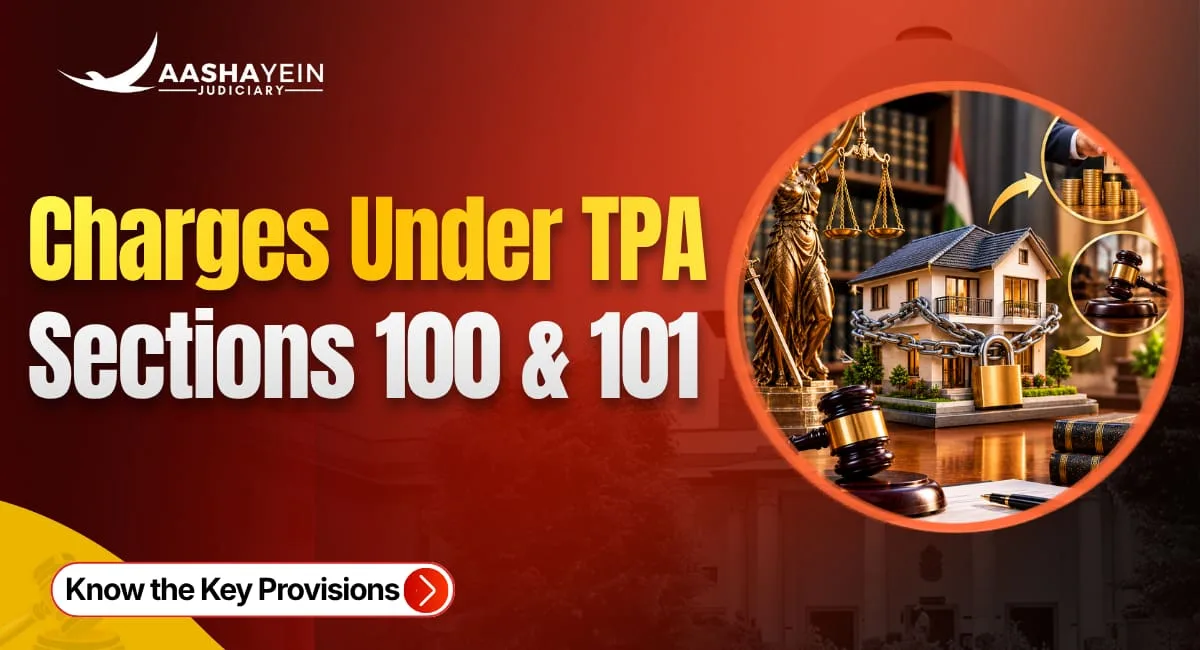
A charge and a mortgage both give a lender security over immovable property. Yet the law treats them differently, and examiners love to ask where exactly the line falls. The answer sits in Sections 100 and 101 of the Transfer of Property Act, 1882.
Do not confuse this charge with a charge in criminal procedure or with provisions of the Code of Civil Procedure. Here we deal only with the charge on immovable property under Sections 100 and 101 of the Transfer of Property Act, 1882. Check section numbers in your Bare Act as you revise.
Where charges fit in the Act
Sections 58 to 104 of the Transfer of Property Act deal with mortgages and charges. Section 58 defines a mortgage as a transfer of an interest in specific immovable property to secure payment of money advanced or to be advanced, an existing or future debt, or the performance of an engagement that may give rise to a money liability. Ownership stays with the mortgagor, and some interest passes to the mortgagee. The three conditions are a transfer of interest, in specific immovable property, with consideration.
What Section 100 says
As the article explains, Section 100 deals with the situation where immovable property of one person is made security for the payment of money to another, and the transaction does not amount to a mortgage. That is a charge. The provisions that apply to a simple mortgage apply to a charge as well.
The article draws out these points:
· A charge can be created by act of the parties or by operation of law.
· It is a security for payment of money.
· The transaction does not amount to a mortgage.
· A charge can be enforced by a suit.
· A charge can be extinguished by act of the parties through release of the debt, by novation or by merger.
The most important idea is that a charge does not transfer any interest in the property to the charge holder. He only gets the right to recover his money out of the property.
Also Check: Section 3 TPA: Transferable and Non-Transferable Claims
Charge versus mortgage
Point | Mortgage | Charge |
Purpose | Created only for payment of a debt | Security for payment of money, which may not always be a debt |
Agreement to pay | There is an agreement that a party will pay the money | No such formal agreement is needed |
Interest in property | Transfers an interest in immovable property | No transfer of interest to the charge holder |
Relationship | Every mortgage is a charge | Every charge is not a mortgage |
Time to enforce | Simple mortgage within 12 years; other mortgages within 30 years | Within 12 years |
The article's line is worth memorising: every mortgage is a charge, but every charge is not a mortgage.

Charge versus lien
Point | Charge | Lien |
How created | By act of parties or by operation of law | Only by operation of law |
Property | Only immovable property | Movable or immovable property |
Possession | Not possessory | Possessory |
Section 101: no merger when a later interest is acquired
Section 101 says that a mortgagee, a charge holder, or a transferee from either, may acquire further rights in the property of the mortgagor without merging the original mortgage or charge. This applies as between that person and a subsequent mortgagee of the same property, and between that person and a person who holds a charge on the same property.
The article adds that a subsequent mortgage or charge cannot be sold or foreclosed without redeeming the prior mortgage or charge.
How to use this in the exam
For a short note on charge, give the Section 100 definition and the five points above. For a comparison question, use the charge versus mortgage table. For a problem question, ask three things. Is there a transfer of an interest in the property? If yes, it is a mortgage. If the property is only security and no interest passes, it is a charge. And was it created by the parties or by operation of law?
A short reminder: the 12-year and 30-year periods are the article's statement of limitation for enforcement. Check the present limitation provisions in your Bare Act before quoting them in an answer.
Questions Aspirants Ask About Charge Under the TPA
Which section of the Transfer of Property Act defines a charge?
Section 100, with Section 101 dealing with no merger in case of a subsequent encumbrance.
Does a charge transfer an interest in the property?
No. The charge holder only has the right to recover money from the property.
Can a charge be created by law?
Yes. It can be created by act of the parties or by operation of law.
How is a charge enforced?
By a suit, according to the article.
How can a charge be extinguished?
By release of the debt, novation or merger.
Is every mortgage a charge?
The article says every mortgage is a charge, but not every charge is a mortgage.
Which provisions apply to a charge?
The provisions that apply to a simple mortgage.
What is the difference between a charge and a lien?
A charge can arise by act of parties or by law, applies only to immovable property and is not possessory. A lien arises only by operation of law, applies to movables or immovables and is possessory.
What does Section 101 provide?
That a mortgagee or charge holder can acquire further rights in the same property without merger of the mortgage or charge.
What makes a transaction a charge and not a mortgage?
The property is made security for payment of money, but no interest in it is transferred to the charge holder.
Remember This Line
In a mortgage, an interest in the property passes. In a charge, it does not. That one difference explains most of the rest of the topic.
Nitesh Sir and the Aashayein Judiciary team simplify property law with short Judiciary Notes, PYQ practice and Mock Tests for the Civil Judge Exam preparation, PCS J Exam and APO Exam. For structured Judiciary Coaching, Online Judiciary Coaching and reliable Judiciary Study Material, join Aashayein Judiciary today.

About Aashayein Team
Legal Expert
Start Your Journey
Join 50,000+ aspirants and get access to premium courses, study material, and expert guidance.
Enroll NowView All CoursesFree Resources
Newsletter
Get weekly updates on legal news, judgments, and exam tips.