Key Details at a Glance
Detail | Information |
Hearing Date | July 28, 2026 (Tuesday), 3:00 PM |
Court | Supreme Court of India |
Case | Bhumika Trust v. Union of India, WP(C) No. 1110 of 2025 |
Issue | Mandatory 3 year legal practice rule for entry level judicial service exams |
Exam Affected | Civil Judge (Junior Division) Exam across states |
Earlier Relief | Deadline extensions for applications and provisional counting of law clerk experience |
Supreme Court Takes Up 3 Year Practice Rule Today
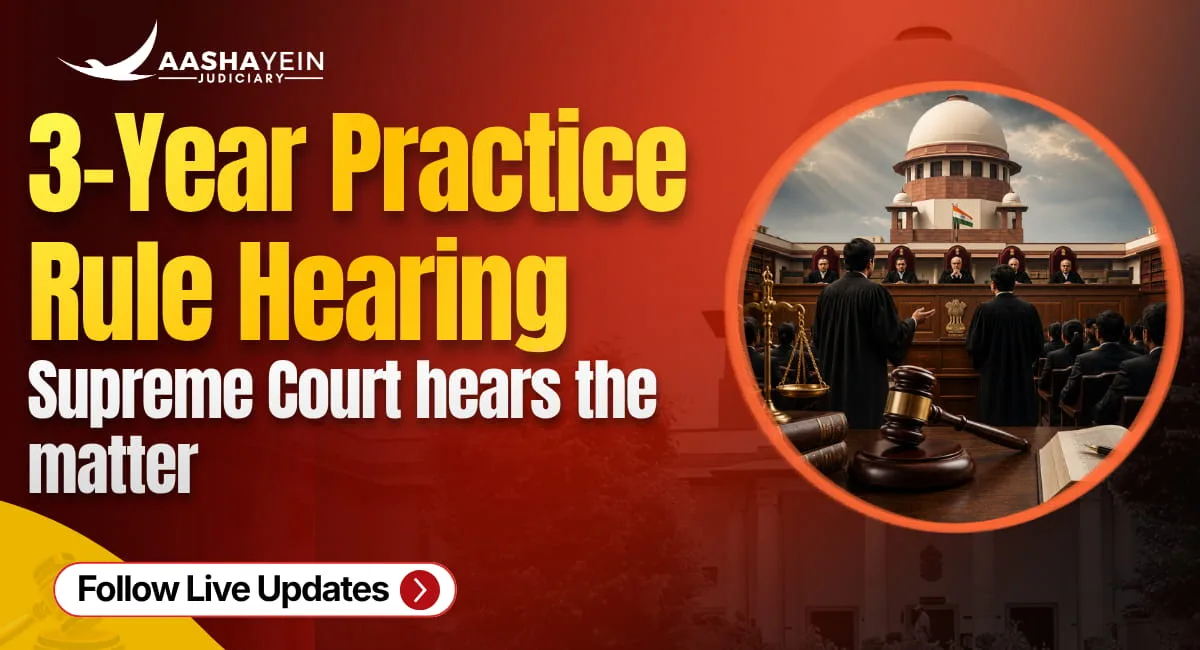
The Supreme Court of India has listed a special hearing on the 3 year legal practice rule for today, July 28, 2026, at 3:00 PM. This is one of the most closely watched matters for judiciary aspirants right now. The case deals with the rule that says a law graduate must complete three years of active legal practice before they can sit for entry level judicial service exams such as the Civil Judge (Junior Division) exam.
The hearing is part of review proceedings in Bhumika Trust v. Union of India. If you are preparing for the Civil Judge Exam, PCS J Exam, or any other state judiciary exam, this case affects your eligibility directly. So it is worth understanding exactly where things stand before the court sits today.
Who Is Hearing the Case
Reports indicate the bench includes Chief Justice of India Surya Kant, along with Justice Augustine George Masih and Justice K Vinod Chandran. This bench has handled earlier stages of the 3 year practice rule matter as well, so today's hearing is a continuation of a case the court already knows closely.
How the 3 Year Practice Rule Case Reached This Point
To understand today's hearing, it helps to look at how this issue developed over the last year or so.
• A Supreme Court bench led by then CJI B.R. Gavai, along with Justices A.G. Masih and K. Vinod Chandran, restored the 3 year practice requirement for Civil Judge (Junior Division) posts in May 2025. The court held that fresh law graduates without courtroom exposure were struggling once appointed as judges.
• A separate matter, In re Recruitment of Visually Impaired in Judicial Services, had already asked for suitable changes to eligibility conditions for specially abled candidates at the junior division level.
• Bhumika Trust then filed a writ petition on behalf of specially abled candidates, asking for an exemption from the 3 year rule.
• On January 15, 2026, the court said eligibility conditions should ideally be uniform for all categories of candidates. It asked every High Court and National Law University to send in suggestions within four weeks.
• On March 13, 2026, the bench extended the last date for Civil Judge (Junior Division) applications to April 30, 2026, so that the review process would not disadvantage anyone. News reports from that hearing noted the CJI's view that the 3 year condition itself should stay, and that the real question was how to apply it fairly, including for women and specially abled candidates.
• On May 22, 2026, the matter was mentioned again, and the court extended its interim order on application deadlines until further orders.
What Might Happen at Today's Hearing
Nobody can predict a court's ruling with certainty, and this blog will not speculate beyond what has already been reported. Based on the pattern so far, today's hearing could bring one of a few outcomes. The court may pass a fresh interim order extending timelines again, it may lay down final modalities on how the 3 year rule applies to different categories of candidates, or it may reserve judgment for a later date. Aspirants should treat any of these as possible and keep checking official sources rather than assuming a final verdict will come out today.
What This Means for Judiciary Aspirants Right Now
This case is not framed around exam stages like Prelims, Mains, or Interview, since it is a legal proceeding about eligibility rather than a syllabus topic. Here is what Aashayein Judiciary suggests aspirants keep in mind while this matter is being heard.
• Keep your Bar Council enrollment and practice records updated, since proof of the 3 years is likely to matter regardless of how the court rules on exemptions.
• Continue your Civil Judge Exam and PCS J Exam preparation. Eligibility questions do not change how much subject knowledge you need.
• Watch official High Court and State Public Service Commission notifications for your state, since implementation timelines can vary.
• Use this waiting period to strengthen your PYQ practice and attempt regular Mock Test series so you are ready the moment applications open.
Why This Case Matters So Much
The 3 year practice rule changes who can even apply for the Civil Judge Exam. For candidates from financially modest backgrounds, three unpaid or low paid years at the Bar can be difficult to manage. For states like Madhya Pradesh, Rajasthan, Uttar Pradesh, and Bihar, which earlier allowed fresh law graduates to apply directly, any final ruling from the Supreme Court would mean rewriting their recruitment rules. This is why today's hearing is being tracked so closely by aspirants, coaching institutes, and law schools across the country.
Prepare for the Judicial Services Exam with expert-led Judiciary Preparation Courses designed for Prelims, Mains, and Interview. Learn through comprehensive study material, regular mock tests, case law updates, and personalized mentorship to build strong legal concepts and maximize your chances of selection.
Frequently Asked Questions
What is happening in the Supreme Court on July 28, 2026?
The Supreme Court is holding a hearing on the 3 year legal practice rule for entry level judicial service exams, as part of the review petition in Bhumika Trust v. Union of India.
What time is the hearing scheduled?
The hearing is listed for 3:00 PM on July 28, 2026.
Which bench is hearing the case?
Reports indicate the bench includes Chief Justice of India Surya Kant, Justice Augustine George Masih, and Justice K Vinod Chandran.
What is the 3 year practice rule?
It is a rule that requires candidates to complete three years of active legal practice at the Bar before they can apply for entry level judicial service posts such as Civil Judge (Junior Division).
When was the 3 year practice rule restored?
The Supreme Court restored the rule in May 2025 through a bench led by then CJI B.R. Gavai, along with Justices A.G. Masih and K. Vinod Chandran.
Who filed the current petition being heard?
Bhumika Trust filed the writ petition, seeking an exemption from the 3 year rule for specially abled candidates.
Has the Supreme Court given any relief so far?
Yes. The court has repeatedly extended the last date for submitting applications for Civil Judge (Junior Division) posts and has allowed provisional counting of experience such as law clerkships.
Will fresh law graduates be allowed to apply after this hearing?
That depends on the court's final view. As of the last recorded order, the 3 year practice condition continues to apply, and the court has indicated it wants uniform eligibility criteria for all categories.
Should I stop preparing for the Civil Judge Exam until this is resolved?
No. Subject preparation, PYQ practice, and Mock Test attempts remain useful regardless of how the eligibility rule is finally settled.
Where can I get updates on this case and on judiciary exam eligibility?
Aashayein Judiciary tracks these developments closely and shares timely updates along with Judiciary Notes and Judiciary Study Material for aspirants.
Conclusion
The 3 year practice rule has been one of the most debated eligibility questions in judiciary exam preparation over the past year, and today's Supreme Court hearing is another important step in that story. Whatever the outcome, aspirants preparing for the Civil Judge Exam, PCS J Exam, APO Exam, and other judicial services exams should stay focused on their preparation while keeping an eye on official updates.
Nitesh Sir and the team at Aashayein Judiciary will continue to track this case and share verified updates as they come in. For structured guidance, updated Judiciary Notes, and expert mentorship through every stage of your judiciary exam journey, explore Online Judiciary Coaching with Aashayein Judiciary.

About Aashayein Team
Legal Expert
Start Your Journey
Join 50,000+ aspirants and get access to premium courses, study material, and expert guidance.
Enroll NowView All CoursesFree Resources
Newsletter
Get weekly updates on legal news, judgments, and exam tips.