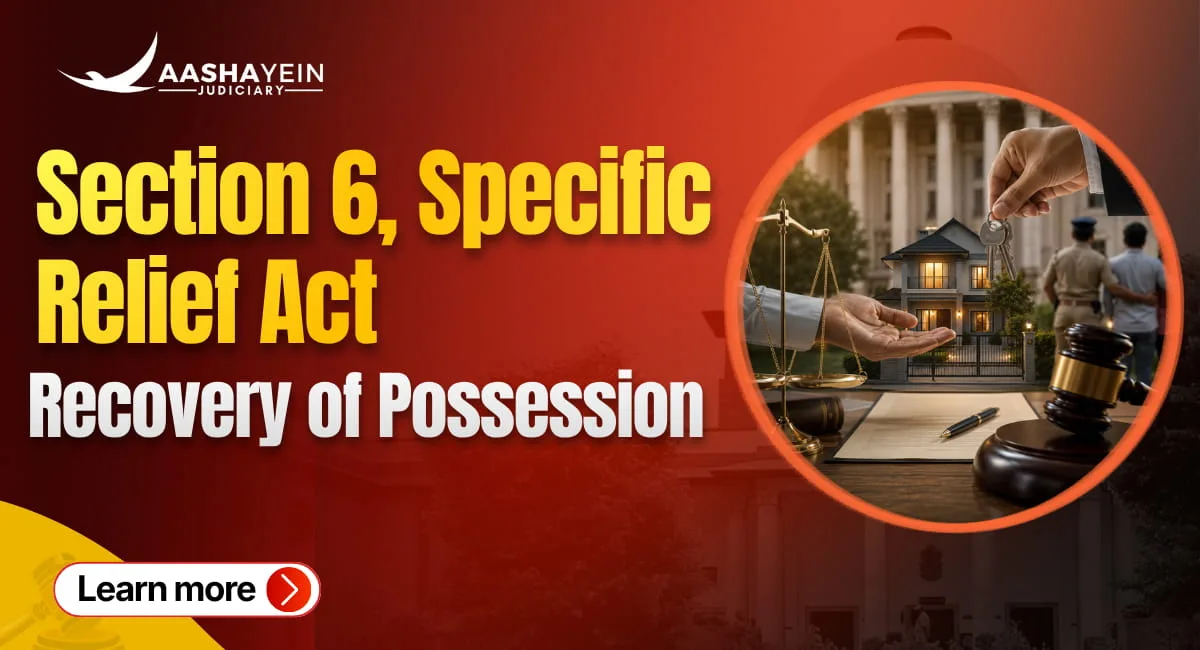
If someone forcibly throws you out of your own property without going through any legal process, should the law require you to first prove your ownership before you can even get your possession back? Section 6 of the Specific Relief Act, 1963 says no. It offers a quick, possession-focused remedy that lets a dispossessed person recover the property without having to fight a full title dispute first. This provision is a favourite in judiciary exams because it rewards precise, section-by-section understanding.
Key Details
Concept | Suit by Person Dispossessed of Immovable Property |
Governing Provision | Section 6, Specific Relief Act, 1963 |
Time Limit | Six months from the date of dispossession |
Bar | No suit under Section 6 can be brought against the Government |
Amendment | Specific Relief (Amendment) Act, 2018, extended the right to title holders and their agents |
Key Cases | East India Hotels Ltd. v. Syndicate Bank (1992); Mahabir Prasad Jain v. Ganga Singh (1999); Katta Sujatha Reddy v. Siddamsetty Infra Projects (P) Ltd. (2022) |
Protection Against Unlawful Dispossession
Section 6 provides that if a person is removed from immovable property without their consent, and not through due course of law, they have the right to file a suit to recover possession of that property. This right applies even if the person filing the suit does not hold ownership or any other title to the property; possession alone is sufficient to claim recovery. The right also extends to anyone who was in possession through the dispossessed person, or who claims under them.
Time Limit and Restrictions
Two important limits apply to a suit under Section 6:
• The claim must be filed within six months from the date of dispossession.
• Such a suit cannot be brought against the Government.
No Appeals or Reviews Allowed
Any decision or decree passed in a suit under Section 6 cannot be challenged through an appeal, nor can it be reviewed under this section. The ruling given by the trial court is final for the purposes of this specific remedy, which reflects the summary and urgent nature of the relief being offered.
Preparing for the Judicial Services Examination requires consistency, conceptual clarity, and the right guidance. Judiciary Exam Courses are designed to help aspirants master the syllabus through expert-led classes, comprehensive study material, regular mock tests, and structured preparation, ensuring better performance in competitive law exams.
Right to Prove Ownership Separately
Section 6 does not stop anyone from filing a separate suit to establish their ownership of the property and recover possession based on that title. It simply offers an immediate remedy against dispossession, without getting into the question of who actually owns the property. Ownership disputes are left to be resolved through an ordinary title suit, filed independently of any action under Section 6.
Essential Elements of Section 6
To succeed in a suit under Section 6, the following conditions must be established:
• Valid possession: at the time of dispossession, the plaintiff must have had lawful possession of the property.
• Non-consensual dispossession: the plaintiff must have been dispossessed without their consent.
• Dispossession not in due course of law: the act of dispossession must not have followed proper legal procedure.
• Right to recover possession: if the plaintiff's possession was valid and the dispossession was unlawful, they can recover possession of the specific property, even if the defendant sets up a claim of title against them.
• Time limit: the suit must be filed within six months of the date of dispossession.
• Restriction against the Government: a suit under Section 6 cannot be filed to recover possession from the Government.
As noted, no appeal lies from a decree passed in such a suit, and review petitions are also not permitted.
Who Can File a Suit: The 2018 Amendment
Before the Specific Relief (Amendment) Act, 2018, Section 6 allowed any person forcibly dispossessed, or someone claiming through them such as a tenant or mortgagee, to file a suit. However, the property owner, their agent, or another authorised representative could not file a suit under this section to recover possession if it was a tenant or lessee, rather than the owner, who had been dispossessed.
The 2018 Amendment introduced a significant change, extending the right to title holders and their agents or authorised representatives to file suits for recovering possession, in the same manner that this right was previously available only to persons deriving possession through the title holder.
Landmark Cases
In East India Hotels Ltd. v. Syndicate Bank (1992), the court explained that the purpose of Section 6 is to restrain a person from using force to dispossess someone without their consent and outside due process of law.
In Yeshwant v. Jagdish (1968), the court clarified the meaning of due course of law, holding that it requires a person to have the opportunity to be heard, present evidence, and defend their rights before any judgment affecting their property, liberty, or life is pronounced.
In Mahabir Prasad Jain v. Ganga Singh (1999), the Supreme Court emphasised that equitable relief under the Specific Relief Act is available only to those who approach the court with clean hands.
In K.K. Verma v. Union of India (1954), the court held that legal, or juridical, possession can exist even without actual possession or a rightful origin. For example, a trespasser who is allowed to remain on a property unchallenged by the owner may still acquire possession recognised under Section 6, and similarly, a tenant's continued possession after the tenancy has ended is treated as juridical possession.
More recently, in Katta Sujatha Reddy v. Siddamsetty Infra Projects (P) Ltd. (2022 SCC OnLine SC 1079), the Supreme Court held that the 2018 amendment to the Specific Relief Act applies only prospectively, meaning it does not affect transactions that occurred before the amendment came into force.
Strong preparation begins with the right study resources. Judiciary Notes provide concise, exam-focused coverage of important legal concepts, landmark judgments, and key provisions, making revision faster and helping aspirants perform confidently in Judicial Services, APO, and ADPO examinations.
Frequently Asked Questions
What does Section 6 of the Specific Relief Act, 1963 provide?
That a person dispossessed of immovable property without their consent and outside due course of law can file a suit to recover possession, based on possession alone, without needing to prove title.
What is the time limit for filing a suit under Section 6?
The suit must be filed within six months from the date of dispossession.
Can a suit under Section 6 be filed against the Government?
No. Section 6 expressly bars such suits from being brought against the Government.
Can a decree passed in a Section 6 suit be appealed?
No. No appeal lies from any order or decree passed in a suit under Section 6, and review is also not allowed.
Does Section 6 prevent a person from later filing a suit to establish ownership?
No. Section 6 does not bar a separate suit to establish title and recover possession based on that title.
What changed under the Specific Relief (Amendment) Act, 2018?
It extended the right to file a suit under Section 6 to title holders and their agents or authorised representatives, a right previously limited mainly to persons deriving possession through the title holder.
Does the 2018 amendment apply retrospectively?
No. As held in Katta Sujatha Reddy v. Siddamsetty Infra Projects (P) Ltd. (2022), the amendment applies only prospectively and does not affect transactions before it came into force.
What does due course of law mean in this context?
As explained in Yeshwant v. Jagdish (1968), it means a person must have the opportunity to be heard, present evidence, and defend their rights before a judgment affecting their property is pronounced.
Can a trespasser acquire possession recognised under Section 6?
Yes. As held in K.K. Verma v. Union of India (1954), juridical possession can exist even where the original entry was not rightful, such as a trespasser left unchallenged by the owner.
Why is Section 6 considered a summary remedy?
Because it focuses solely on possession rather than title, provides a quick remedy within a short time limit, and does not allow appeal or review of the decree.
Conclusion
Section 6 of the Specific Relief Act, 1963 exists to discourage people from taking the law into their own hands. By focusing purely on possession rather than title, it gives a quick and effective remedy to anyone unlawfully dispossessed, while still leaving room for a proper title suit later if ownership itself is disputed. For judiciary aspirants, the essential elements, the time limit, and the 2018 amendment together form a compact but important area of the Specific Relief Act.
Prepare for Judicial Services, APO, and ADPO exams with Online Judiciary Coaching that offers live classes, recorded lectures, expert guidance, mock tests, and comprehensive study material. Learn from anywhere with a flexible, exam-oriented approach designed to strengthen legal concepts and maximize your chances of success.

About Aashayein Team
Legal Expert
Start Your Journey
Join 50,000+ aspirants and get access to premium courses, study material, and expert guidance.
Enroll NowView All CoursesFree Resources
Newsletter
Get weekly updates on legal news, judgments, and exam tips.