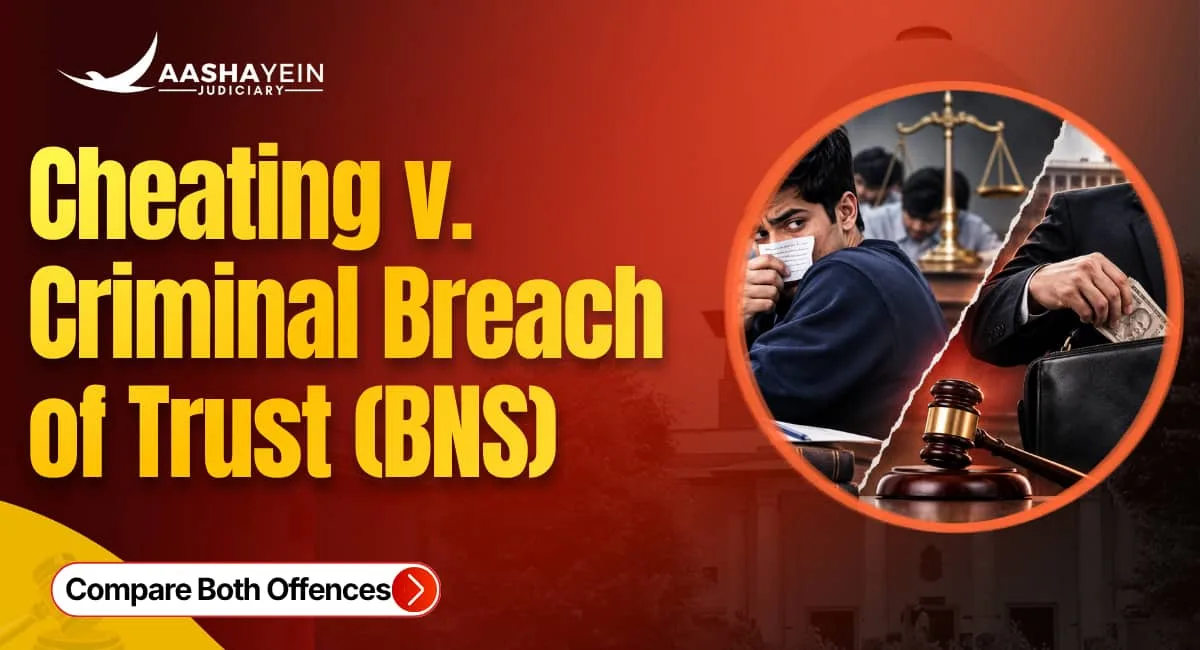
A shopkeeper takes advance money, never delivers the goods and disappears. Is it cheating, or is it a broken promise? And how is it different from an employee who is entrusted with cash and keeps it? The new criminal code answers both, in different sections.
Cheating: Section 318 BNS
Section 318 has four parts, according to the source.
• Section 318(1) defines cheating.
• Section 318(2) gives punishment of up to 3 years for cheating.
• Section 318(3) gives up to 5 years where the cheated person is one whom the offender knew to be under his protection or special trust (check the bare act for the exact wording).
• Section 318(4) deals with cheating that dishonestly induces delivery of property. It carries up to 7 years and a fine. This is the old Section 420 of the IPC.
Related sections: Section 319 is cheating by personation, Section 308 is extortion and Section 316 is criminal breach of trust.
Criminal breach of trust: Section 316 BNS
Here the property is handed over lawfully, and then misused. The wrong lies in dishonestly misappropriating or using it against the trust. The main difference from cheating is when the dishonest intention arises.
Cheating versus breach of trust
Point | Cheating | Criminal breach of trust |
Intention | Dishonest intention at the start | Dishonesty arises after entrustment |
Delivery of property | Obtained by deception | Voluntarily entrusted |
Section | 318 BNS | 316 BNS |
Why intention at the start matters
Courts do not treat every broken promise as cheating. If a person never meant to keep the promise, it is cheating. If he meant to but failed, it is a civil wrong. The cases in the source include Mahadeo Prasad (AIR 1954 SC 724), Hridaya Ranjan Prasad Verma (2000) 4 SCC 168, Vijay Kumar Ghai (2022) 7 SCC 124, Sarabjit Kaur (2023) 5 SCC 360, Deepak Gaba (2023) 3 SCC 423 and A.M. Mohan 2024 INSC 233.
Also Check: Common Intention vs Common Object: Key Differences
Procedure note
The source gives a table of whether the offence is bailable, cognizable and compoundable and refers to Section 359 BNSS for compounding. It also contains a possible inconsistency about which sections it covers, so verify procedural details in the bare act before using them in an answer.
Start your journey with judiciary coaching in India. Strengthen legal concepts, practise PYQs and prepare confidently for Judiciary Exams.
Frequently asked questions
Which section of BNS defines cheating?
Section 318(1).
What is the punishment under Section 318(4)?
Up to 7 years and fine.
Which old IPC section does it replace?
Section 420.
Which section deals with criminal breach of trust?
Section 316 BNS.
What is the main difference between cheating and breach of trust?
When the dishonest intention arises.
Which section covers personation?
Section 319.
Name a Supreme Court case on cheating.
Hridaya Ranjan Prasad Verma (2000) 4 SCC 168.
Closing note
Ask one question: was the intention dishonest at the very start? That single question separates cheating from a civil dispute.
At Aashayein Judiciary, Nitesh Sir maps old IPC sections to BNS in our Judiciary Notes. Use our PYQ and Mock Test series, and join our Online Judiciary Coaching for the Civil Judge Exam, PCS J Exam and APO Exam.

About Aashayein Team
Legal Expert
Start Your Journey
Join 50,000+ aspirants and get access to premium courses, study material, and expert guidance.
Enroll NowView All CoursesFree Resources
Newsletter
Get weekly updates on legal news, judgments, and exam tips.