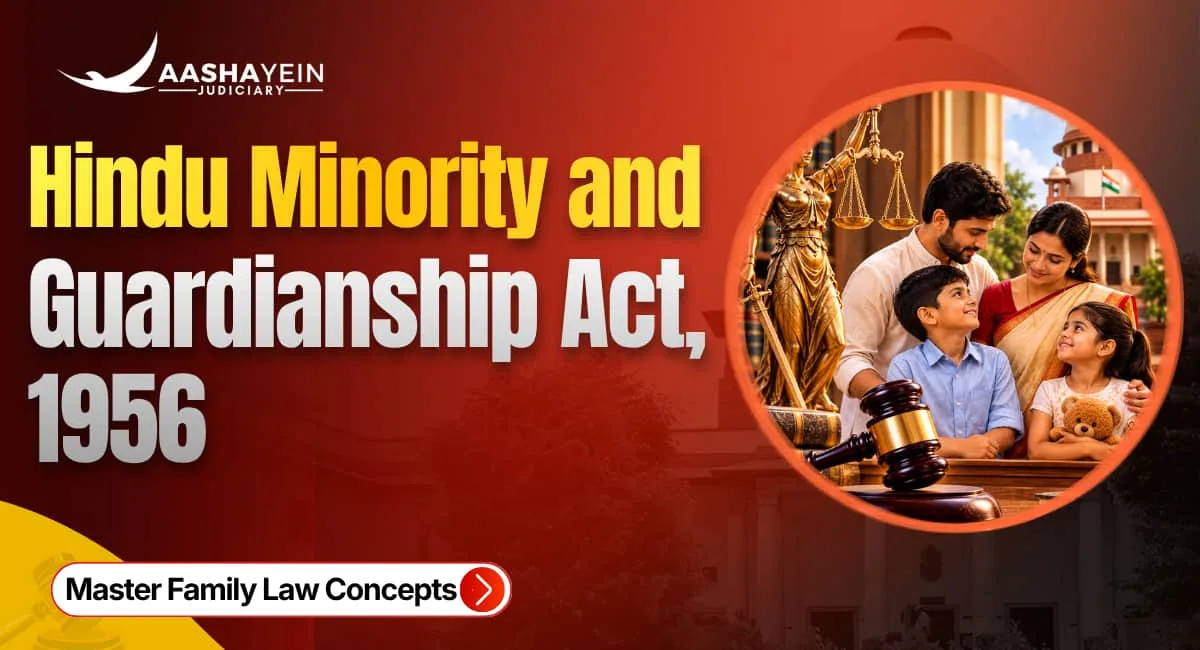
If a Hindu child's parents are living apart, who is the natural guardian? The text of Section 6 says the father first and the mother after him. The Supreme Court has read those words in a way that changes the practical answer.
This blog explains who is covered, who the natural guardians are, how the Supreme Court read the word after in Gita Hariharan v Reserve Bank of India, and what reforms were suggested. It is meant for aspirants of the Civil Judge Exam, PCS J Exam and APO Exam. Match section numbers with your Bare Act.
Why the Act exists
The article says old Hindu texts say little about guardianship, because a child without parents was looked after by the head of the joint family. The 1956 Act, part of the Hindu Code Bills along with the Hindu Marriage Act, Hindu Succession Act and Hindu Adoption and Maintenance Act, codified the law with the welfare of the child at its centre.
The Act does not replace the earlier laws. Section 2 says it is in addition to, and not in derogation of, the Guardians and Wards Act, 1890 and the Indian Majority Act, 1875. The article notes that the Guardians and Wards Act applies to everyone regardless of community, while the 1956 Act applies to Hindus and those treated as Hindus.
Who is covered
The article lists Hindus, Lingayats, Virashaivas, followers of the Brahmo and Prarthana Samaj, Arya Samajists, Buddhists, Sikhs and Jains. It says Muslims, Christians, Parsis and Jews are not covered. Both legitimate and illegitimate minors are covered if at least one parent falls within these groups.
A minor is a person below 18. The article adds that, under the Indian Majority Act, the age of majority is 21 if a guardian has been appointed for the person.
Natural guardians and the priority question
Section 6 names the natural guardians of a Hindu minor, for the person and for the property. For a boy or an unmarried girl, the father is the natural guardian, and after him the mother. A plain reading therefore suggests the mother's right is suspended while the father is alive, and begins only when he dies.
The article explains the objection. This reading is said to carry a gender bias and to conflict with the constitutional position, since it ties the mother's guardianship to the father's life. The whole spirit of the Act is the welfare of the child, so the interpretation should fit that purpose and not be narrow or literal.
Also Check: Unlawful Assembly Under BNS Sections 189 and 190
Gita Hariharan v Reserve Bank of India
The Supreme Court dealt with this in Githa Hariharan v Reserve Bank of India, AIR 1999, (1999) 2 SCC 228, as cited in the article. It did not change the section. It read the word after in Section 6 to mean in the absence of the father, and not only after his death. Absence, the article explains, can include a father who is away for a long time, indifferent to the child or unfit through illness.
For the facts and the full reasoning of Gita Hariharan, read the judgment itself before you cite more than its main holding.
The practical result: the father is still preferred in the text, but the mother can act as natural guardian in exceptional circumstances, such as the father's absence, and the child's welfare is the guiding factor. That is the answer to the priority question.
The adopted child
Section 7 says that on adoption, the natural guardianship of an adopted son who is a minor passes to the adoptive father and after him to the adoptive mother. The article points out that the provision speaks only of an adopted son. At the time of the 1956 Act, adoption of daughters was allowed only by custom, and the Hindu Adoption and Maintenance Act, 1956, which was passed shortly after, recognised adoption of daughters. The article describes this as a conflict between the two Acts that was left unresolved.
What the Law Commission suggested
According to the article, the Law Commission's 2015 report on custody and guardianship recommended changes to both the Guardians and Wards Act and the 1956 Act. Its main points were:
· Section 6(a) should be changed so that the mother and the father are both natural guardians at the same time, with the welfare of the minor as the paramount consideration, in line with Article 14.
· Section 7 should cover both an adopted son and an adopted daughter, and both adoptive parents should be natural guardians.
· The Guardians and Wards Act, being a secular law, should get a new chapter on custody and visitation, with ideas such as joint custody, child support, mediation, parenting plans and grandparenting time.
The article also mentions a 2010 amendment to Section 19 of the Guardians and Wards Act, 1890. The section had stopped a court from appointing a guardian for a minor whose father was alive and fit. The amendment extended this to cases where the mother is alive, which removes the father's preferred position in that Act.
How to write this in an exam
A good answer has four parts. First, the scope of the Act and its link with the 1890 Act and the 1875 Act under Section 2. Second, the text of Section 6 on natural guardians. Third, Gita Hariharan and the reading of after as in the absence of. Fourth, the position on adopted children in Section 7 and the reform suggestions.
Also remember that the court's guiding principle in guardianship matters is the welfare of the child. A trial judge dealing with a custody or guardianship petition will apply the welfare test first and the text of the section second.
Frequently Asked Questions on Guardianship of Hindu Minors
Who is a minor under the Act?
A person below 18 years, according to the article. If a guardian has been appointed, the Indian Majority Act sets majority at 21.
Who are the natural guardians of a Hindu boy or unmarried girl?
The father, and after him the mother, under Section 6.
How did the Supreme Court read the word after in Section 6?
In Gita Hariharan v Reserve Bank of India, it read it as in the absence of the father, and not only after his death.
Does the Act replace the Guardians and Wards Act, 1890?
No. Section 2 says it is in addition to, and not in derogation of, that Act and the Indian Majority Act, 1875.
Who is covered by the Act?
Hindus and persons treated as Hindus, including Buddhists, Sikhs, Jains and others the article lists. Muslims, Christians, Parsis and Jews are not.
What does Section 7 deal with?
Natural guardianship of an adopted son who is a minor, passing to the adoptive father and then the adoptive mother.
Why is Section 7 criticised?
Because it mentions only an adopted son, while the Hindu Adoption and Maintenance Act recognised the adoption of daughters.
What did the Law Commission recommend for Section 6?
That mother and father be natural guardians together, with the welfare of the minor paramount.
What changed in Section 19 of the Guardians and Wards Act in 2010?
The bar on appointing a guardian where the father was alive and fit was extended to cases where the mother is alive.
What is the guiding principle for all guardianship decisions?
The welfare of the minor.
Final Pointers
Remember the line: the father first by the text, but the mother can act in his absence under the reading in Gita Hariharan, and the child's welfare is the compass for every decision.
Nitesh Sir and the Aashayein Judiciary team simplify family law with Judiciary Notes, PYQ analysis and Mock Tests for the Civil Judge Exam, PCS J Exam and APO Exam. For guided Judiciary Coaching, Online Judiciary Coaching and trusted Judiciary Study Material, join Aashayein Judiciary today.

About Aashayein Team
Legal Expert
Start Your Journey
Join 50,000+ aspirants and get access to premium courses, study material, and expert guidance.
Enroll NowView All CoursesFree Resources
Newsletter
Get weekly updates on legal news, judgments, and exam tips.