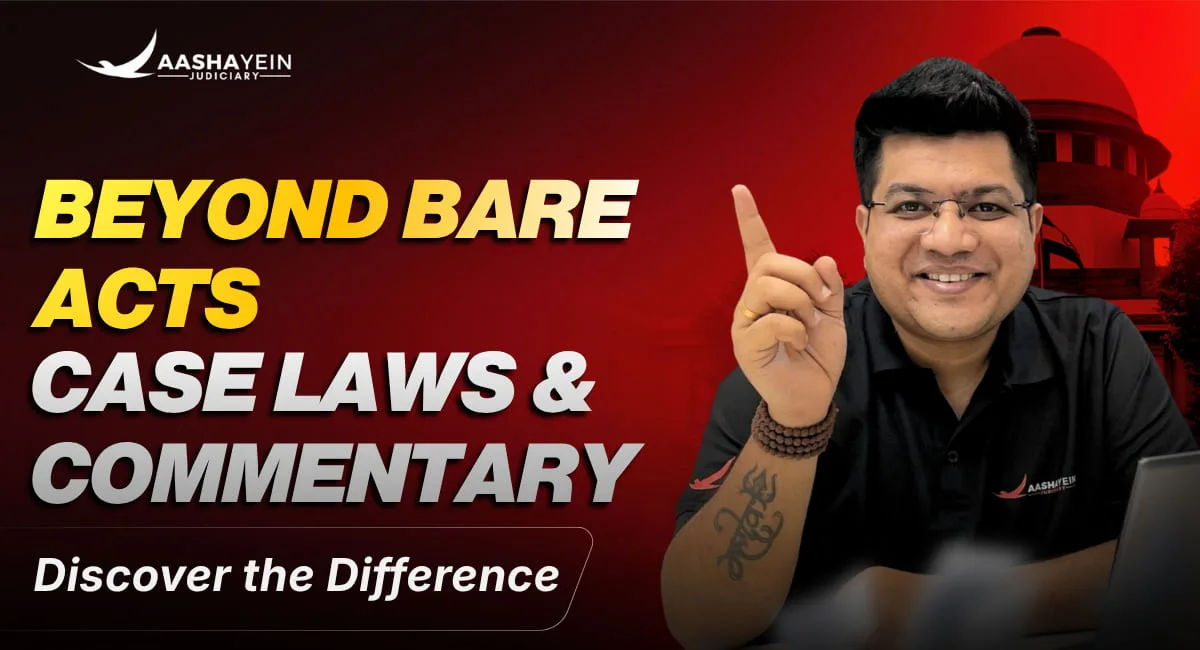
Read the section. Learn the section. Write the section. Is that enough to clear the judiciary exams? Many toppers say that bare acts are the foundation. Almost none say that they are the whole building.
This blog explains what a bare act gives you, what it cannot give you, and how to add case law and commentary without drowning in books. It is written for aspirants of the Civil Judge Exam, PCS J Exam and APO Exam.
What a bare act gives you
A bare act is the enacted text of a statute, with no commentary. It includes sections, sub-sections, definitions, provisos, explanations, illustrations, exceptions, schedules and amendments that have been incorporated. Because it carries no commentator's opinion, it is the most reliable source of the exact words of the law.
That exactness matters because exam questions often turn on a single word. Look at the traps listed in one guide on this topic.
• "Shall" versus "may".
• "And" versus "or".
• "Within thirty days" versus "within sixty days".
• "Unless the contrary is proved" versus "reasonable grounds".
Reading the bare act also teaches you legal vocabulary, helps you remember frequently tested sections and definitions, and helps you quote the right section in an answer. It helps in the interview too, since interviewers may ask about specific sections.
What a bare act cannot give you
One article on the subject says it in a single line: a bare act tells you what the law says, and a standard book explains what the law means. A bare act does not explain why a provision exists, how courts have read it, or where its limits lie.
Here is where the gap shows. Take res judicata under the Code of Civil Procedure. The bare act gives you the exact provision. A standard book explains its ingredients, exceptions and illustrations, and the judgments that have shaped it. A mains question on res judicata wants all of these, not just the section.
The same article says that bare acts are the starting point for prelims, where they help with definitions, limitation periods, jurisdiction, punishments and eliminating wrong options. For mains, descriptive answers test explanation, analysis and application, not memory alone. That is where the bare act alone falls short.
Read Also: Judicial Hierarchy in India: Court Structure Explained
Three layers: bare act, standard book, case law
Layer | What it gives | Where it helps most |
Bare act | The exact words of the law: sections, provisos, explanations, illustrations | Prelims, definitions, time limits, finding the right section in a mains answer |
Standard book or commentary | Meaning, purpose, practical examples, distinctions, legislative history, exceptions | Concepts such as res judicata, mens rea, burden of proof, estoppel, basic structure and natural justice |
Case law | How courts clarified unclear text, explained ingredients, read down or struck down provisions, or created tests | Mains answers, where one well-chosen case turns a statutory word into a usable test |
Which subjects need which layer
Not every subject needs the same mix.
• Heavy bare act reading: Civil Procedure Code, criminal procedure, evidence, Indian Contract Act, Specific Relief Act, Transfer of Property Act, Limitation Act, the Constitution, and local or minor laws.
• More textbook support: Constitutional law, administrative law and jurisprudence, where the principles developed largely through case law.
How to supplement without overloading
The most common mistake is to add too much. Case law should be selective. For mains, prepare a limited list of landmark and recent judgments that explain core principles. Do not fill your notes with every case you find.
Where do you find these cases? The sources named are standard books, case-law compilations, judgment summaries of landmark cases, and online platforms such as SCC Online, Manupatra and government websites for updated bare acts and case law. Coaching study material can supplement self-study, and commentaries and reference books give deeper explanation of complex provisions.
Watch Our You Tube Video: COI One Shot | Complete Constitution of India
A routine that works
• First reading: Read the bare act for understanding. Open a standard book only when the language is hard. Aim for clarity, not memorisation.
• Second reading: Focus more on the bare act. Mark definitions, provisos, explanations and connected sections. Start solving previous-year questions.
• Revision: Give the bare act the highest priority. Return to a standard book only for topics that are still unclear.
• Before prelims: Bare acts, previous-year questions, mock tests, short notes and important amendments. Do not start lengthy new textbooks.
• Before mains: Bare acts, case laws, doctrines, answer structures, subject notes and previous mains questions.
For mains, the suggested sequence is to read the bare act, understand it through one standard book, add key cases, make structured notes, and then practise writing answers without the book.
A model structure for a mains answer
The guide offers a seven-step structure that uses all three layers.
• Relevant section.
• Legal rule.
• Essential ingredients.
• Exceptions or provisos.
• Important judicial interpretation.
• Application to facts.
• Clear conclusion.
Notice where each layer enters. Steps one to four come from the bare act. Step five is case law. Steps six and seven are your own reasoning, trained by practice.
Mistakes to avoid
• Relying only on textbook summaries, which can hide provisos, exceptions, time limits, competent authorities and procedural conditions.
• Studying only bare acts, which leaves you without reasons, interpretation or application, so descriptive answers turn weak.
• Reading standard books without linking each topic back to the relevant bare act.
• Overloading notes with too many case laws.
• Starting new, lengthy textbooks shortly before prelims.
• Treating reading as enough without practising answer writing from memory.
• Rote memorisation without understanding the context, and ignoring definitions, provisos and exceptions.
How to check that you have the balance right
Pick any section you have studied. Can you quote its key words from memory? Can you explain, in your own words, what it means and give one case or example? Can you write a short answer on it in the structure above within the time limit? If the answer to any of these is no, you know which layer is missing.
Frequently Asked Questions
Q1. What is a bare act?
It is the enacted text of a statute, including sections, definitions, provisos, explanations, illustrations, exceptions, schedules and incorporated amendments, without commentary.
Q2. Why are bare acts important for judiciary exams?
They give the exact wording of the law, and many questions turn on single words such as "shall" versus "may" or "and" versus "or".
Q3. What can a bare act not do?
It does not explain why a provision exists, how courts have interpreted it, or what its limits are.
Q4. What do standard books add?
Meaning, purpose, practical examples, distinctions between related ideas, legislative history and exceptions.
Q5. Why is case law needed?
Courts clarify ambiguous text, explain ingredients, read down or strike down provisions, and create tests that mains answers can use.
Q6. Should I learn many cases for mains?
No. Prepare a limited list of landmark and recent judgments that explain core principles, and avoid overloading notes.
Q7. Which subjects need the most bare act reading?
CPC, criminal procedure, evidence, Contract Act, Specific Relief Act, Transfer of Property Act, Limitation Act, the Constitution and local laws.
Q8. Which subjects need more textbook support?
Constitutional law, administrative law and jurisprudence.
Q9. What is a good order of study for mains?
Read the bare act, understand it through one standard book, add key cases, make structured notes, and practise writing without the book.
Q10. Where can I find updated bare acts and case law?
On platforms such as SCC Online, Manupatra and government websites, along with commentaries, judgment summaries and coaching study material.
Build the full picture with Aashayein Judiciary
Bare acts tell you what the law says. Books and cases tell you what it means. You need both, and you need practice to join them.
Nitesh Sir and the Aashayein Judiciary team teach every major Act with the section, the explanation and the key cases side by side. Join our Online Judiciary Coaching to get Judiciary Notes, Judiciary Study Material, PYQ discussion and Mock Test practice for the Civil Judge Exam, PCS J Exam and APO Exam.

About Aashayein Team
Legal Expert
Start Your Journey
Join 50,000+ aspirants and get access to premium courses, study material, and expert guidance.
Enroll NowView All CoursesFree Resources
Newsletter
Get weekly updates on legal news, judgments, and exam tips.