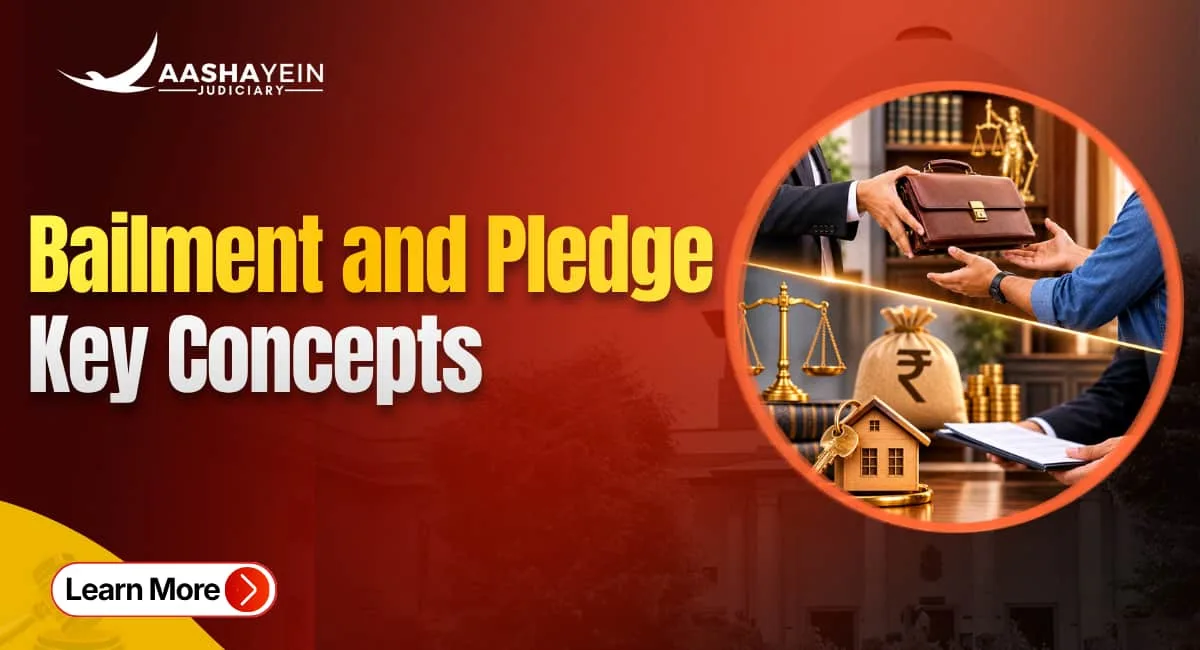
You leave your watch at a repair shop. You give your gold chain to a lender as security for a loan. In both cases someone else now holds your goods. The Indian Contract Act, 1872 calls the first a bailment and the second a pledge, which is a special kind of bailment.
What is bailment
Section 148 defines bailment as the delivery of goods by one person to another for some purpose, under a contract that the goods will be returned or disposed of as the owner directs when the purpose is done. The giver is the bailor and the receiver is the bailee.
Note the key idea: only possession passes. Ownership stays with the bailor.
Duties of the bailee
• Care. Section 151 requires the bailee to take as much care of the goods as a man of ordinary prudence would take of his own goods of the same kind.
• Loss. Section 152 deals with loss, destruction or deterioration of goods. If the bailee has taken the care required by Section 151, he is not responsible.
• No unauthorised use. Section 154 makes the bailee liable for any damage caused by using the goods in a way not allowed by the bailment.
What is pledge
Section 172 defines pledge as the bailment of goods as security for payment of a debt or performance of a promise. The bailor is the pawnor and the bailee is the pawnee.
Read Blog: Free Consent in Contract Law
Rights of the pawnee
Sections 173 to 177 give the pawnee rights, such as retaining the goods for the debt and for certain expenses, and the right to sell the goods after giving reasonable notice if the pawnor defaults. Check the bare act for exact conditions.
How they differ
Point | Bailment | Pledge |
Purpose | Any purpose agreed | Security for debt or promise |
Goods | Delivered for a purpose | Delivered as security |
Right to sell | Not usually | Yes, after notice on default |
Parties | Bailor and bailee | Pawnor and pawnee |
Cases from the source
• Kaliaperumal Pillai v. Visalakshmi, AIR 1937 Mad 32.
• Atul Mehra v. Bank of Maharashtra (2002).
• Taj Mahal Hotel v. United India Insurance (2019, Supreme Court).
• Morvi Mercantile Bank v. Union of India (1965).
• Lallan Prasad v. Rahmat Ali (1996, Supreme Court).
Our source does not cover Sections 178 and 178A, which deal with pledge by certain persons other than the owner. Read them from the bare act.
Common confusions
A hotel guest who leaves a car with a valet may be a bailor. Whether the hotel is a bailee depends on facts, which is why the Taj Mahal Hotel case is worth reading.
Explore comprehensive judiciary preparation courses at Aashayein Judiciary, designed to help aspirants crack Civil Judge and PCS-J examinations with expert guidance, live classes, structured study materials, and regular mock tests.
Frequently asked questions
What is bailment?
Delivery of goods for a purpose under a contract to return them, defined in Section 148.
What is pledge?
Bailment of goods as security for a debt or promise, under Section 172.
What care must a bailee take?
Ordinary prudence, under Section 151.
When is a bailee not liable for loss?
When he took the Section 151 care, under Section 152.
What does Section 154 say?
A bailee is liable for damage from unauthorised use.
Who is a pawnee?
The person who receives goods as security in a pledge.
Which sections give the pawnee his rights?
Sections 173 to 177.
Name a Supreme Court case on this topic.
Taj Mahal Hotel v. United India Insurance (2019).
Closing note
Bailment is about possession for a purpose and pledge is bailment for security. Keep Sections 148, 151, 152, 154 and 172 as your anchors.
At Aashayein Judiciary, Nitesh Sir teaches this with workplace examples. Use our Judiciary Notes, PYQ and Mock Test series, and join our Online Judiciary Coaching for the Civil Judge Exam, PCS J Exam and APO Exam.

About Aashayein Team
Legal Expert
Start Your Journey
Join 50,000+ aspirants and get access to premium courses, study material, and expert guidance.
Enroll NowView All CoursesFree Resources
Newsletter
Get weekly updates on legal news, judgments, and exam tips.