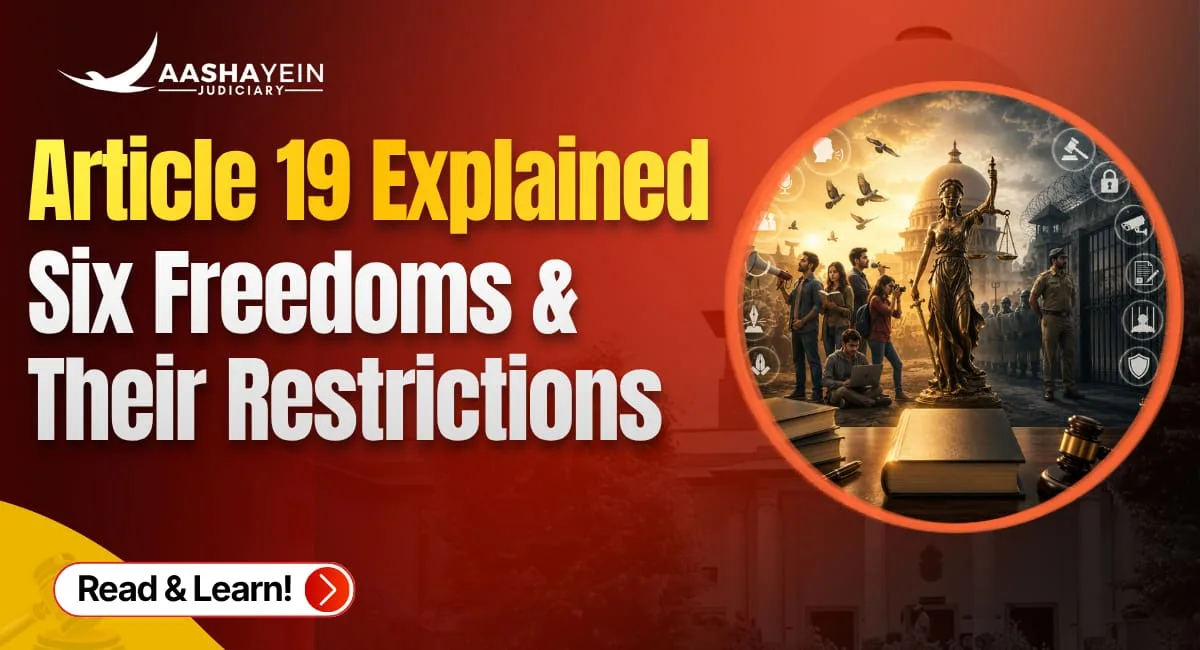
Article 19 of the Indian Constitution guarantees certain basic freedoms to citizens, forming the core of individual liberty in India. It is one of the most tested provisions in judiciary exams, appearing in prelims, mains and even interview rounds.
This article breaks down each of the freedoms under Article 19, along with the reasonable restrictions the state can impose on them, so you can build a clear and confident understanding of this crucial topic.
Key Details
Detail | Information |
Article | Article 19 |
Applicable To | Citizens of India only, not foreigners or companies |
Total Freedoms | Six, after the 44th Amendment removed the right to property |
Restriction Clauses | Article 19(2) to 19(6) |
Key Test | Reasonableness, laid down in State of Madras v. V.G. Row (1952) |
The Six Freedoms Under Article 19(1)
• Freedom of speech and expression, under Article 19(1)(a).
• Freedom to assemble peacefully and without arms, under Article 19(1)(b).
• Freedom to form associations or unions or cooperative societies, under Article 19(1)(c).
• Freedom to move freely throughout the territory of India, under Article 19(1)(d).
• Freedom to reside and settle in any part of India, under Article 19(1)(e).
• Freedom to practise any profession, or to carry on any occupation, trade or business, under Article 19(1)(g).
Reasonable Restrictions Under Article 19
None of the freedoms under Article 19 are absolute. Clauses 2 to 6 allow the state to impose reasonable restrictions on these freedoms in the interest of specific grounds such as sovereignty and integrity of India, security of the state, public order, decency, morality, contempt of court, defamation, and incitement to an offence.
The word reasonable is doing a lot of work here. A restriction that is excessive, arbitrary, or disproportionate to the object it seeks to achieve will not pass constitutional muster, even if it falls under one of the listed grounds.
The Reasonableness Test
The leading authority on how courts test reasonableness is State of Madras v. V.G. Row (1952), where the Supreme Court held that reasonableness must be judged from both a substantive and a procedural standpoint, and that no single, fixed standard can apply to every case.
Courts generally look at factors like the nature of the right, the extent and urgency of the evil sought to be remedied, the proportionality of the restriction, and the availability of procedural safeguards for the person affected. This flexible, case-by-case approach continues to guide courts in modern cases, including those involving internet shutdowns and public assembly restrictions.
Why Article 19 Freedoms Are Only for Citizens
Unlike Articles 14 and 21, which extend to all persons, Article 19 freedoms are available only to citizens of India. Foreign nationals and, generally, companies cannot claim these rights directly, though a company's action can sometimes indirectly affect the rights of its individual citizen shareholders, as seen in R.C. Cooper v. Union of India (1970).
Build strong legal concepts and exam confidence with a Judiciary Preparation Course designed for focused and effective preparation.
Frequently Asked Questions
Q1. How many freedoms does Article 19 guarantee?
Article 19(1) guarantees six freedoms after the right to property was removed by the 44th Amendment.
Q2. Who can claim rights under Article 19?
Only citizens of India can claim these freedoms, not foreign nationals or, generally, companies.
Q3. What is the reasonableness test?
It is the standard laid down in State of Madras v. V.G. Row (1952) requiring courts to examine both the substance and procedure of a restriction, without applying a single fixed standard.
Q4. Can the state restrict freedom of speech under Article 19?
Yes, under Article 19(2), on grounds such as sovereignty, public order, decency, morality, defamation and incitement to an offence.
Q5. Was the right to property always part of Article 19?
Yes, until the 44th Amendment in 1978 removed it, converting it into a legal right under Article 300A instead.
Q6. Why is Article 19 important for judiciary exams?
It is one of the most frequently tested provisions, forming the basis of many questions on fundamental rights and reasonable restrictions.
Q7. Can a company claim rights under Article 19?
Generally no, but shareholders of a company can sometimes indirectly claim protection, as seen in R.C. Cooper v. Union of India.
Conclusion
Article 19 forms the backbone of individual freedom in India, balanced carefully against the collective interests of society through reasonable restrictions. A clear grasp of each freedom and its corresponding restriction is essential for judiciary exam success.
Aashayein Judiciary, guided by Nitesh Sir, brings you detailed, exam-focused explainers like this one to help you master constitutional law with confidence.Build your Judiciary Exam preparation with Online Judiciary Coaching that offers expert guidance, quality study material, regular mock tests, and a structured approach to help you prepare with confidence.

About Aashayein Team
Legal Expert
Start Your Journey
Join 50,000+ aspirants and get access to premium courses, study material, and expert guidance.
Enroll NowView All CoursesFree Resources
Newsletter
Get weekly updates on legal news, judgments, and exam tips.